

INTRODUCTION
Smoking is a major risk factor for developing coronary heart disease, stroke, aortic aneurysm, and peripheral artery disease (PAD)1. Approximately one-third of the estimated 8.7 million smoking-related deaths per year are attributed to cardiovascular diseases2. Increased awareness of the risks associated with tobacco smoke led to the implementation of anti-smoking policies, prompting the tobacco industry to develop new products, such as heated tobacco products (HTPs), marketed as less harmful than conventional cigarettes3. However, HTPs emissions are known to contain several well-known tobacco smoke-associated toxicants, and current literature provides contradictory findings on the relative risk of HTP use compared to conventional tobacco products4.
In vivo and in vitro studies comparing the cardiovascular effects of HTPs with those of conventional cigarettes conducted or funded by the tobacco industry generally suggest that switching to HTPs may lead to less detrimental impact on parameters of cardiovascular functionality (e.g. systolic and diastolic blood pressure and heart rate)5-7. However, independent literature reports more critical findings regarding the effects of HTPs on parameters of cardiovascular activity, suggesting that HTP use may cause arrhythmias, arterial stiffness, and cardiovascular disease with a similar magnitude of risk as conventional cigarettes4,8-11.
At least six industry-independent intervention studies based on 17 to 40 conventional tobacco users have been conducted to evaluate the acute effects of HTP use on selected cardiovascular outcomes in humans. All of these studies described significant alterations in these parameters, including those related to arterial stiffness, heart rate, diastolic and systolic blood pressure, after the use of HTPs12-17. A cross-over randomized trial on 20 conventional cigarette smokers found a significant increase in systolic and diastolic blood pressure after HTP use, but to a less extent compared to conventional cigarettes17. Belkin et al.12 used a randomized crossover trial based on 40 cigarette smokers to show that HTPs use increased primary biomarkers (high-sensitivity C-reactive protein and white blood cell count) similarly to conventional cigarettes, and resulted in endothelial dysfunction and arterial stiffness to a less extent than cigarette smoke. A study by Ioakeimidis et al.14 on 22 current conventional cigarette smokers showed that both HTP and conventional cigarette use were associated with increases in heart rate, blood pressure, and arterial stiffness. A similar study by Franzen et al.15 on 20 smokers found significant increases in systolic blood pressure and heart rate after using either IQOS or conventional cigarettes. A study on 17 occasional smokers by Goebel et al.16 found that HTP use leads to an acute increase in arterial stiffness and cardiovascular stress, with a substantial increase in heart rate and systolic blood pressure after use. These results suggest that use of HTPs can acutely increase arterial stiffness, cardiovascular stress, and risk factors for atherosclerosis, with most of the evidence indicating highly similar effects to those of conventional cigarettes. To the best of our knowledge, none of the available studies considered a comparison with non-users/non-smokers, nor did they differentiate between exclusive HTP users and exclusive cigarette smokers12-17.
Given the increasing popularity of HTPs and claims of reduced risk compared to conventional cigarettes, there is an urgent need for more industry-independent studies measuring the acute cardiovascular effects of HTP emissions in exclusive users of these products. Therefore, the Acute Health Impact of IQOS (AHIQOS) study was conducted, which aimed to assess the acute effect of exclusive IQOS use on several cardiovascular parameters, and to compare these effects with those of both exclusive cigarette smokers and never smokers of tobacco products. The study was conducted in Italy with one of the highest rates of HTP use, and the first European country where this HTP was launched18. Moreover, in this study, the puffing behavior of exclusive HTP users and exclusive cigarette smokers was characterized.
METHODS
Study design
This study was performed in the metropolitan city of Milan, Italy, in the period March–June 2024. This investigation was initially described as an observational study, as participants were free to smoke or use HTPs at their discretion. However, it could also be considered a quasi-experimental study, since participants were indirectly prompted to smoke when the research team was ready to proceed with measurements. The study was coordinated by the Mario Negri Institute (Milan, Italy), the Dutch National Institute for Public Health and the Environment (RIVM, The Netherlands), and Maastricht University (The Netherlands). The study protocol was approved by the Ethics Committee of Mario Negri Institute (Ethics Committee of Fondazione IRCCS Istituto Neurologico Carlo Besta, ID: 15, date: 17 May 2023).
Within this study, three groups of adult participants (i.e. aged ≥18 years) were recruited: 1) never smokers (NS, i.e. people who never smoked cigarettes, electronic cigarettes, or HTPs); 2) exclusive users of conventional cigarettes (CS, i.e. manufactured or roll-your-own [RYO] cigarettes); and 3) exclusive users of the heated tobacco product IQOS (IU). Subjects of the three groups were frequency-matched according to gender (male, female) and age group (i.e. 18–29, 30–44, 45–54 years).
Recruitment and eligibility criteria
Potentially eligible study participants were approached via email, social media, and through flyers. They were asked to fill in a survey focused on their demographic characteristics and on their use of conventional cigarettes, electronic cigarettes, and HTPs. Furthermore, information regarding their general health status and self-reported diagnosis of main respiratory, cardiovascular, and metabolic conditions was collected. These data were used to assess the eligibility of each candidate.
Inclusion and exclusion criteria for each of the three study groups are summarized in Supplementary file Table 1. Never smokers were considered eligible if they never used conventional cigarettes, electronic cigarettes, or HTPs. Conventional cigarette smokers were considered eligible if they smoked ≥4 conventional manufactured or roll-your-own (RYO) cigarettes per day for ≥1 year. IQOS users were eligible when consuming ≥4 IQOS sticks (either HEETS for IQOS or TEREA for IQOS ILUMA) per day for at least 6 months, without consuming any other tobacco or nicotine product. Inclusion criteria common to all three study groups included the absence of the following health conditions: cancer, smoking-related respiratory diseases (e.g. chronic obstructive pulmonary disease), metabolic diseases, cardiovascular risk factors or cardiovascular disease (e.g. high blood pressure, high heart rate), aspects of metabolic syndrome, and use of medication associated with cardiovascular disease (e.g. blood pressure lowering medication, β-blockers, cholesterol-lowering medication). Moreover, participants with a body mass index (BMI, kg/m2) <18.5 (underweight) or >25.0 (overweight) were not eligible for participation in this study. Finally, pregnant or lactating women were also excluded from the study. Eligible subjects were assigned to one of the three study groups, depending on their current smoking or HTP use status. Before taking part in the study, each participant provided written informed consent and received information regarding data confidentiality and treatment of data.
Questionnaire and measurements
Eligible participants were welcomed at the facilities of the Mario Negri Institute, read the information sheet, and were asked to sign the consent form. Subsequently, all participants completed a baseline questionnaire, in which they were asked to fill in their demographic characteristics (i.e. age and gender) and lifestyle habits (i.e. alcohol consumption). Moreover, detailed information on the use of conventional cigarettes (both manufactured and RYO), use of HTPs, and use of electronic cigarettes was obtained.
Parameters of cardiovascular functionality were measured for all the participants at baseline (T0, i.e. immediately after completing the questionnaire). After baseline measurements, CS and IU were informed that they had the possibility to consume their tobacco product in a designated outdoor area of the Mario Negri Institute at their discretion. During the smoking session, the puffing behavior of both cigarette smokers and HTP users was recorded via video to ensure precise documentation of their puffing parameters. Upon the end of the smoking session, parameters of cardiovascular functionality were measured at T1 (i.e. immediately at the end of the smoking session for cigarette smokers and HTP users, or ten minutes after the previous measurements for the group of never users). At the end of the T1 measurements, participants were thanked for their participation and were free to leave the study facilities.
Participant compensation
All participants (independently from the study cohort) were informed prior to taking part in the study that their participation would be acknowledged with a €20 Amazon gift card. All participants included in the study received an Amazon gift card upon participation.
Cardiovascular functionality
Prior to participation, all participants were instructed to abstain from using any nicotine products and from consuming food for at least one hour. This was the only restriction applied. Time of day was also recorded, but it was not included as a variable in the analyses. Upon arrival at the study facilities, participants from all three study groups underwent a 5-minute resting period before baseline cardiovascular measurements. All cardiovascular measurements were performed by a trained researcher, and always by the same person for standardization. Cardiovascular measures included assessment of systolic and diastolic blood pressure (mmHg) and heart frequency (beats per minutes, bpm). These measurements were collected from the left arm supported at heart level of each participant using a commercially available automatic upper arm blood pressure monitor (OMRON), with the participants sitting on a back-supported chair and feet on the floor. These indices of cardiovascular activity were measured at T0 and T1, and one measurement per time-point was performed for all participants.
Puffing behavior
Exclusive cigarette smokers and exclusive IQOS users were allowed to consume their tobacco product in silence and alone, as they would normally do in their routine. They were sitting in a dedicated outdoor study facility, under a gazebo specifically set up for the study.
A commercially available video camera (LOGITECH) was used to film participants during the smoking session, and all participants were informed about the video recording for puffing behavior analysis and expressed their consent about it. The recording was used to determine the total length of the smoking session (minutes) and the number of puffs. The smoking session started when the first puff was taken and was terminated when the cigarette or IQOS stick was taken out of the mouth to be discarded.
The puff duration (seconds) and inter-puff interval (i.e. puff frequency, seconds) of each puff were determined by analyzing the videos using a stopwatch. All analyses were performed retrospectively. The stopwatch was activated each time a puff was initiated (e.g. when a participant placed the tobacco product in the mouth and started to puff) and stopped after the puff was taken (e.g. when the tobacco product was removed from the mouth), to record both puff duration and inter-puff interval. This analysis was performed by three independent assessors, who analyzed all video recordings and reported the total length of each smoking session, the number of puffs, the duration of each puff, and all inter-puff intervals.
Sample size
The sample size calculation was performed using the primary research aim of the increase in heart rate after IQOS use. By using data from a previous study, a sample size of n=25 per group was determined19. Such a sample size allowed for the detection of a mean difference of 7.4 bpm for IQOS users compared to controls with α=0.05 and power=0.819.
Statistical analysis
GraphPad Prism 8.0 software (GraphPad Software, Boston, Massachusetts, USA) was used to carry out statistical analyses and plot the data in graphs. Two-way ANOVAs were used to compare each cardiovascular parameter (i.e. systolic blood pressure, diastolic blood pressure, heart rate) within each study group (T1 vs T0), as well as between study groups at T0 and T1. Unpaired, two-tailed t-tests were employed to examine the mean differences of the measures collected at T1 versus T0 between study groups.
Unpaired, two-tailed t-tests were also applied to compare the four puffing behavior parameters (i.e. length of the smoking session, total number of puffs, puff duration, and puff frequency) between exclusive cigarette smokers and exclusive IQOS users, and statistical significance was set at p<0.05.
RESULTS
Table 1 shows the characteristics of the 78 participants included in the study (27 NS, 25 CS, and 26 IU), matched for gender and age; 57.7% of participants were males and 42.3% were females. In each group, the mean age was between 25.2 and 26.1 years, and the average BMI (kg/m2) was between 21.2 and 21.6. 28 participants announced monthly alcohol consumption: 43 participants had 1–6 alcohol units per week, and only 5 individuals reported daily alcohol consumption. Regarding tobacco use, 70% of CS and 50% of IU reported consuming <10 tobacco units (cigarettes or IQOS sticks) per day, whereas 7 CS and 13 IU reported between 10 and 15 or more units per day. Smokers of both manufactured and RYO cigarettes were eligible, but within the study, all cigarette smokers used a manufactured cigarette.
Table 1
Demographic and behavioral characteristics of study participants by group, Milan, Italy, March–June 2024 (N=78)
| Characteristics | Never smokers n (%) | Exclusive cigarette smokers n (%) | Exclusive IQOS users n (%) |
|---|---|---|---|
| Total, n | 27 | 25 | 26 |
| Sex | |||
| Male | 16 (59.3) | 14 (56.0) | 15 (57.7) |
| Female | 11 (40.7) | 11 (44.0) | 11 (42.3) |
| Age (years), mean (range) | 26.1 (21–45) | 25.2 (19–47) | 25.8 (19–45) |
| BMI (kg/m2), mean (range) | 21.2 (18.5–25.0) | 21.4 (18.5–25.0) | 21.6 (18.5–25.0) |
| Alcohol usea | |||
| None | 1 (3.7) | 0 (0.0) | 1 (3.9) |
| 1–3 units per month | 18 (66.7) | 7 (28.0) | 3 (11.5) |
| 1–6 units per week | 8 (29.6) | 13 (52.0) | 22 (84.6) |
| 1 units per day | 0 (0.0) | 4 (16.0) | 0 (0.0) |
| 2 units per day | 0 (0.0) | 1 (4.0) | 0 (0.0) |
| Tobacco cigarettes/sticks per dayb | |||
| <10 | 17 (70.8) | 13 (50.0) | |
| 10–14 | 2 (8.3) | 6 (23.1) | |
| ≥15 | 5 (20.8) | 7 (26.9) |
While no differences in systolic blood pressure were detected between study groups and time points, a significant increase in diastolic blood pressure (p<0.05) was detected only in the CS group upon product use, as shown in Figure 1B. In addition, the heart rate of both cigarette smokers and IQOS users was substantially elevated upon product use compared with never users (p<0.001) and was significantly higher than the measures obtained at T0, prior to product consumption (p<0.001) (Figure 1C).
Figure 1
Parameters of cardiovascular functionality assessed in all participants (N=78) at T0 and T1: A) Systolic blood pressure; B: Diastolic blood pressure; and C) Heart rate (NS: never smokers, N=27; CS: exclusive cigarette smokers, N=25; and IU: exclusive IQOS users, N=26)
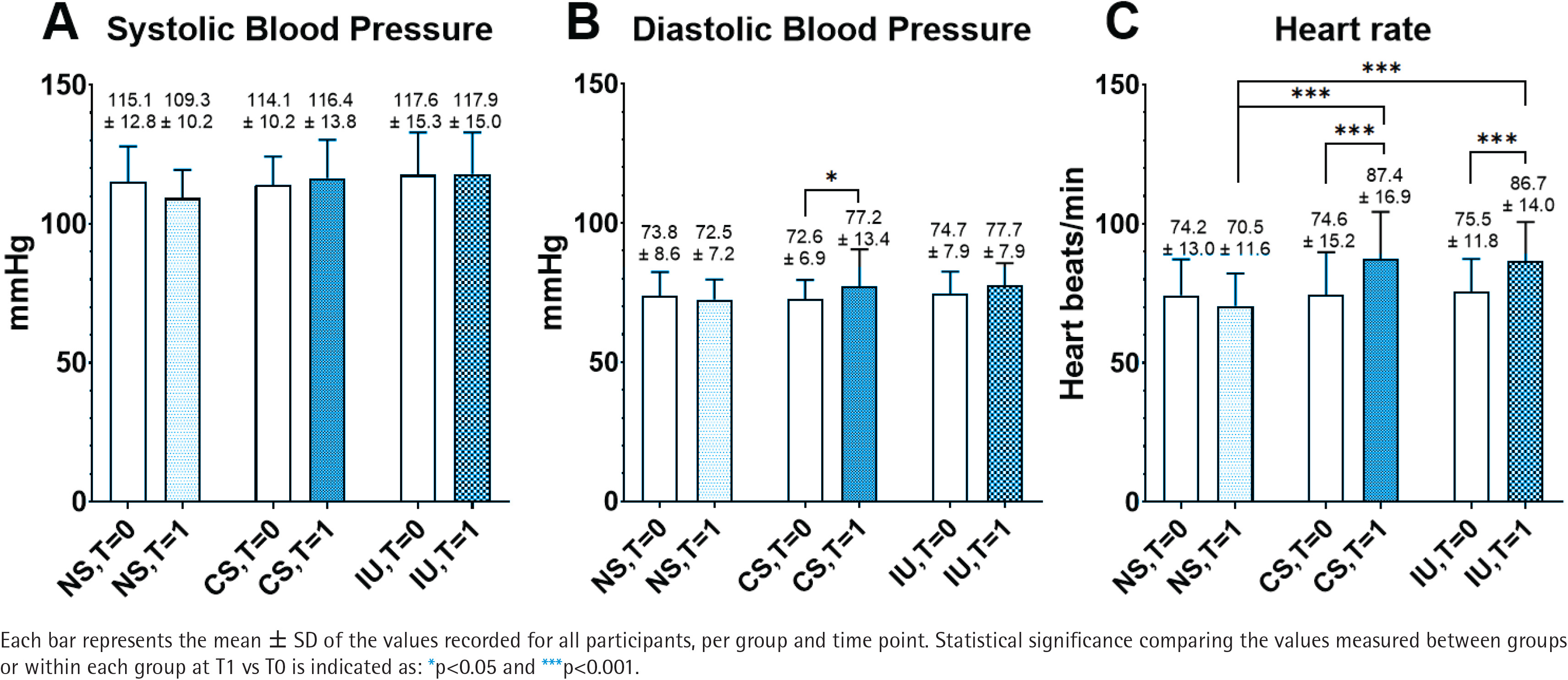
Between T0 and T1, systolic blood pressure, diastolic blood pressure, and heart rate decreased in never smokers (-5.9 mmHg, -1.3 mmHg, -3.7 bpm, respectively) and increased in cigarette smokers (2.4 mmHg, 4.6 mmHg, 12.8 bpm) and in IQOS users (0.3 mmHg, 3.1 mmHg, 11.1 bpm) (Table 2). Changes in systolic blood pressure and heart rate significantly differed between cigarette smokers and never smokers (p<0.001) (Table 2). Changes in all assessed cardiovascular parameters were substantially different between IQOS users and never smokers (p<0.01), and no differences between the two groups of users were identified.
Table 2
Differences between T1 (after product consumption, or after 10 minutes for never smokers) and T0 (baseline) of cardiovascular measures of 27 never smokers, 25 exclusive smokers of conventional cigarettes and 26 exclusive IQOS users, Milan, Italy, March–June 2024
| Measures | Never smokers (NS) mean (SD) | Exclusive cigarette smokers (CS) mean (SD) | Exclusive IQOS users (IU) mean (SD) | CS vs NS pa | IU vs NS pa | IU vs CS pa |
|---|---|---|---|---|---|---|
| Systolic blood pressure (mmHg) | -5.9 (6.9) | 2.4 (6.6) | 0.3 (8.7) | <0.001 | 0.006 | 0.349 |
| Diastolic blood pressure (mmHg) | -1.3 (4.8) | 4.6 (13.7) | 3.1 (6.6) | 0.052 | 0.008 | 0.628 |
| Heart rate (bpm) | -3.7 (6.1) | 12.8 (10.2) | 11.1 (8.8) | <0.001 | <0.001 | 0.529 |
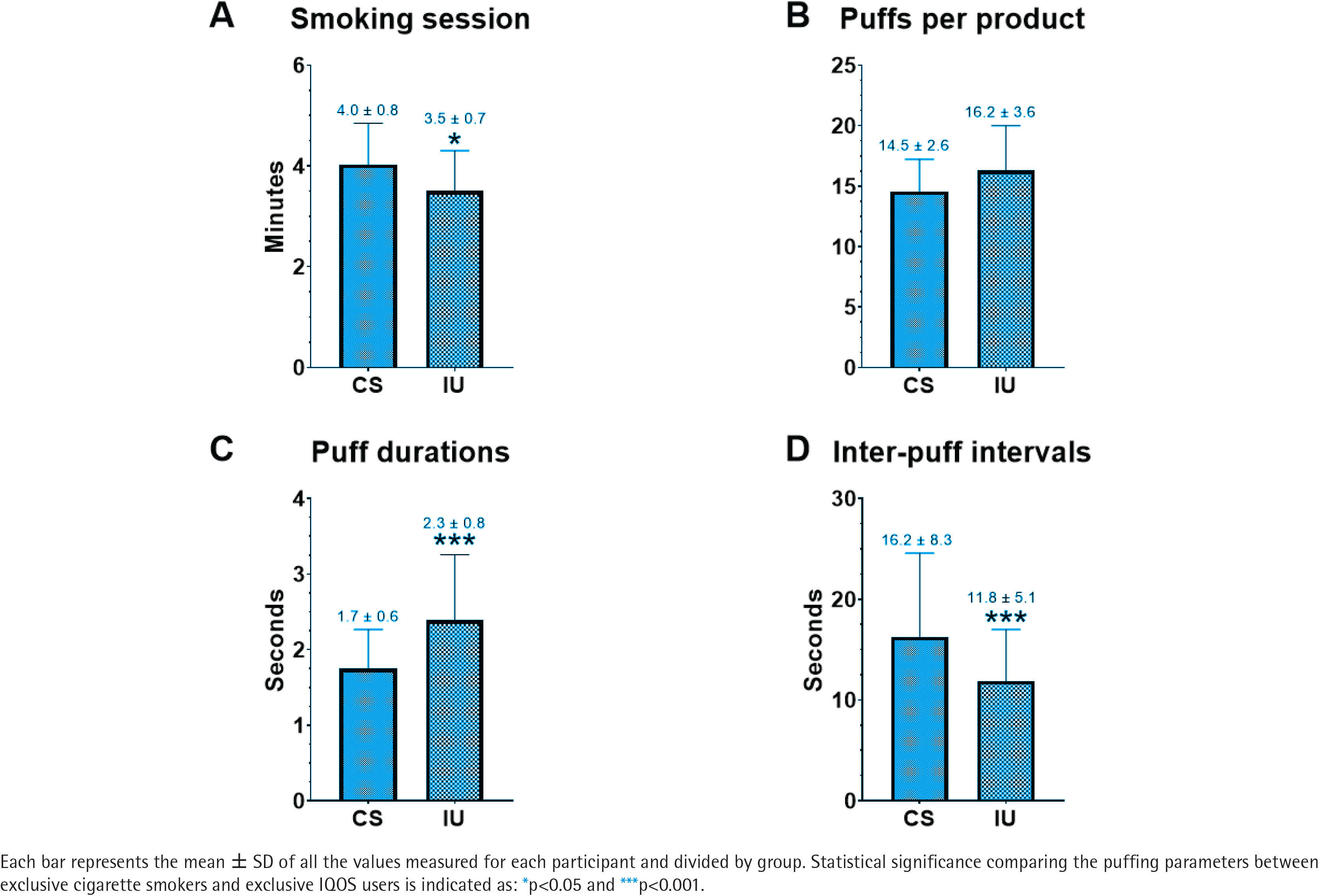
No significant differences in the number of puffs taken were detected between cigarette smokers and IQOS users (p>0.05) (Figure 2B). On the other hand, the smoking session of IQOS users was found to be substantially shorter than that of cigarette smokers (p<0.05), as they took longer and more frequent puffs than cigarette smokers (p<0.001) (Figures 2C and 2D).
Figure 2
Puffing parameters evaluated in exclusive cigarette smokers (N=25) and exclusive IQOS users (N=26) included in the observational human study: A) Total length of the smoking session (minutes); B) Total number of puffs taken from each product; C: Puff durations (seconds); and D: Inter-puff intervals (seconds)
DISCUSSION
Impact of cigarette and IQOS use on cardiovascular functionality
In this study, a significant increase in heart rate in cigarette smokers and IQOS users upon product use was detected, and substantial differences in cardiovascular parameters of cigarette smokers and IQOS users were compared with non-smokers. On the other hand, no significant differences in blood pressure and heart rate were measured between cigarette smokers and IQOS users, suggesting analogous short-term increases in blood pressure and heart rate upon cigarette and IQOS use.
Notably, industry-funded studies compared the impact of combustible cigarettes and IQOS use on cardiovascular parameters in the context of intervention studies, in which cigarette smokers were asked to use IQOS for three months20-22. The outcomes of these studies reported amelioration in the plasma levels of several markers related to cardiovascular risk, platelet activation, endothelial function, oxidative stress, metabolic syndrome, and lipid metabolism in cigarette smokers switching to IQOS20-22. However, two independent studies reported improvement of only four out of 13, and only one out of 24 biomarkers of harm in cigarette smokers switching to IQOS4,23. Furthermore, other industry-independent investigations described impairment of various cardiovascular parameters (left and right ventricle global longitudinal strain, flow-mediated dilation, arterial stiffness, inflammation, wave reflection, blood pressure, and heart rate) in human exposure studies upon cigarette and IQOS use12-17,19,24.
These findings align with previous reports and further support the hypothesis that IQOS use may induce the same acute effects on the human cardiovascular system, specifically an increase in heart rate, as conventional cigarette smoking. These results on the short-term health effects of HTPs can inform policymakers on the appropriate regulation of HTPs.
Moreover, the results can inform campaigns to increase awareness among current and potential future users about the short-term variation of parameters of cardiovascular functionality upon IQOS use.
Puffing behavior of exclusive cigarette smokers and exclusive IQOS users
Although IQOS has been on the market for about 10 years, the smoking behavior of exclusive IQOS users is unknown. As IQOS emissions are known to contain about 50% less nicotine than cigarette smoke, it has been proposed that smokers switching to IQOS (or other HTPs) will apply compensatory puffing to satisfy their nicotine cravings25,26. The smoking topography of HTP users has mainly been investigated in switching studies, in which regular cigarette smokers started to use HTPs. For instance, regular cigarette smokers switching to IQOS for five days were found to take puffs with larger puff volumes, whereas those who switched to the HTP commercialized by British American Tobacco (glo) took more frequent puffs, resulting in overall shorter usage sessions27. Similar observations were reported by industry-funded studies, in which cigarette smokers switching to IQOS or glo increased their daily product consumption and total number of puffs per product, and took longer and more frequent puffs than participants who kept smoking their favorite brand of cigarettes28-31.
The smoking behavior assessment led to the identification of two distinct puffing profiles for exclusive cigarette smokers and exclusive IQOS users: cigarette smokers applied shorter and less frequent puffs, whereas longer and more frequent puffs were taken by IQOS users. As the IQOS users included in the study only consumed their preferred IQOS tobacco sticks, and no regular cigarettes or electronic cigarettes, for at least six months, their smoking profile is based on established puffing habits, which they likely developed to match their desired nicotine intake, per puff and per smoking session. Moreover, cigarette smokers switching to IQOS and established single IQOS users puff more intensely than cigarette smokers, likely due to an adaptation mechanism, to satisfy their nicotine desire and ensure effective nicotine intake27. This has insightful implications, as the majority of HTP users worldwide are cigarette smokers becoming dual users or even poly users of various (e-)cigarettes and HTPs32,33.
These results show that the puffing behavior of exclusive cigarette smokers and exclusive IQOS users is substantially different, and this notion can be used by internationally recognized tobacco testing laboratories to withdraw puffs using real-life puffing topography data25. Furthermore, the findings could be referential for future in vitro or in vivo comparative toxicological assessments, in which cigarette and IQOS emissions can be retrieved by applying real-life puffing parameters of each group of users. This is pivotal to accurately compare the toxicological impact of cigarette and IQOS emissions, considering that using real-life puffing parameters will help to closely mirror the real-life exposure situation34.
Strengths and limitations
A strength of this study resides in having conducted it in Milan, Italy, where both exclusive cigarette smokers and exclusive IQOS users could be enrolled, allowing consideration of exclusive use of each product and excluding dual/poly users. Moreover, a home-like setting was mimicked for the participants, who could consume their tobacco product alone, outdoors, and not restricted in laboratory settings. This strengthens the scientific value of the smoking behavior assessments, as users of both cigarettes and IQOS could puff their product in silence, as they would do in their normal routine. Furthermore, a control group of never smokers was recruited, whose cardiovascular parameters were measured at T0 and T1, as done for cigarette smokers and IQOS users. Also, all participants were frequency-matched and obtained a uniform and homogeneous study population, both within each study group and between study groups. Finally, it needs to be underlined that this study was conducted independently from the tobacco industry and is free from conflicts of interest, ensuring unbiased data collection, analysis, and interpretation.
This study also presents some limitations. While during the recruitment process subjects with chronic cardiovascular and pulmonary conditions were categorically excluded, eligible participants were only required to provide information regarding age, gender, BMI, alcohol consumption and intensity of use of cigarettes or IQOS, whereas no data regarding other lifestyle parameters (e.g. physical activity, diet, stress levels, and sleep quality) that may influence the cardiovascular responses observed in the participants, were collected. Future research is advised on human studies to gather information regarding as many lifestyle indices as possible, to exclude potential confounders and enhance the scientific validity of the retrieved observations. Moreover, all the cardiovascular parameters were measured only at two time points (T0 prior to tobacco product use and T1 immediately after tobacco product use), and not over time for a longer period upon product use. Consequently, the current study design did not allow for the follow-up of the variation in cardiovascular parameters over time, to measure their peak increase as well as their renormalization. Therefore, future research aimed at monitoring the cardiovascular functionality upon cigarette and IQOS use over time is advised, starting at baseline and measuring at regular intervals of time, for about 30 minutes after product consumption35.
Furthermore, only the short-term effects of cigarette and IQOS use on cardiovascular function were assessed, but it is crucial to compare their long-term impacts to determine whether chronic IQOS use may lead to coronary heart disease or other cardiovascular disorders. Finally, the approach to evaluate the smoking profile of cigarette smokers and IQOS users through video recordings did not allow for measuring puff volume, which is an insightful puffing parameter that was found to be increased in cigarette smokers switching to HTPs27. Therefore, it is advisable that future human studies aim at evaluating also the puff volume of different users, potentially using portable measuring devices, such as the portable CReSSmicro™ device, previously used to determine the puffing profile of cigarette users36. In addition, reliance on self-reported questionnaire data for smoking status and health conditions introduces the potential for misclassification bias. Finally, the relatively small sample size included in our study limits statistical power and generalizability.