

INTRODUCTION
Secondhand smoke (SHS) exposure remains a major contributor to the global burden of disease, causing 1.2 million deaths every year1 while being associated with ischemic heart disease, stroke, lung cancer, and other serious conditions2-4. Low- and middle-income countries (LMICs) disproportionately bear roughly 77% of all smoking-related deaths and 89% of all SHS attributed deaths worldwide5. While an increasing number of countries have adopted comprehensive smoke-free policies under the WHO Framework Convention for Tobacco Control (FCTC)6, challenges remain in sufficient adoption and implementation of smoke-free policies in public spaces, such as lacking enforcement mechanisms, low public awareness, and tobacco industry interference7, especially in LMICs8,9.
Globally, successful implementations of smoke-free policy have resulted from strong governance, high levels of public awareness, and multisectoral collaboration from institutional and public actors to promote enforcement10,11. Within this framework, media can play a crucial role in shaping public discourse, communicating legislative changes, disseminating evidence, and influencing awareness and public support.
As a 2017 systematic review summarized, positive media coverage of smoke-free policies can raise salience towards SHS harms, increase public awareness, and counter tobacco use normalization12. Media coverage can also influence policy making; for instance, a 2010 media advocacy campaign in Mexico utilized evidence on tobacco use burden and public opinion to shift legislative vote in support for a tobacco tax, resulting in a tax increase13. Similarly, studies in countries like Namibia and the US have demonstrated the potential of media channels to increase pressure on governments, garner public support, counter misinformation, tailor messages to disseminate knowledge on tobacco risks, and counteract negative framing14,15. News outlets can serve as accessible avenues of mass promoting tobacco control efforts, with media engagement and journalist training identified as crucial strategies to garnering public support in LMICs16.
Several studies have investigated how tobacco control efforts are framed in the media and highlighted both opportunities and challenges associated with media portrayals. An early content analysis in Australia suggested that while tobacco control policies received overall support within media narratives, the extent of audience exposure and engagement was inconsistent17. Another study in the UK showed that during specific legislative events or periods of public interest, tobacco-related media coverage might increase substantially18. Furthermore, while advocacy groups in Australia were found to hold a notable presence in tobacco control media discourse, more research is needed to explore how different argument messengers shape media framing19.
In LMICs, the limited evidence available on tobacco control in the media highlights industry influence on tobacco control measures. For instance, Amalia et al.20 evaluated online media discourse surrounding Indonesia’s 2012 tobacco control regulation, finding divided positioning and arguments on the legislation, including tobacco industry normalization. Similarly, Robichaud et al.21 analyzed LMIC media coverage of the FDA’s Modified Risk Tobacco Product (MRTP) order for IQOS and found widespread misreporting. News outlets framed the FDA’s ‘reduced exposure’ order as a ‘reduced risk’ claim, reflecting media misinterpretation and industry efforts to undermine regulatory efforts. These findings reflect a need for stronger media capacity and critical reporting and mirror calls for more evidence-based narratives supporting tobacco control.
While previous studies have contributed to our understanding of media narratives in tobacco control, research remains limited in examining diverse global legislation and topics, particularly for smoke-free policies in LMICs. Research in highincome countries found that smoke-free policies were largely framed as either beneficial to public health or restrictive to individual freedoms and economic interests in the media18,22. However, literature on this topic disproportionately focuses on high-income countries, leaving media coverage of tobacco control in LMICs – where tobacco burden is highest – largely underexplored.
Furthermore, there is little research on how media frames the implementation and enforcement of smoke-free policies beyond the initial adoption phase. A 2022 review study found that media coverage of smoke-free policies often peaks during legislative changes but fails to be sustained during the critical implementation phases23. And despite spikes in coverage of tobacco control topics, news narratives fail to share clear, health-centered framing, delivering fragmented messages to the public. Additionally, implementation processes present unique challenges – such as ensuring sustained compliance, countering industry interference, and addressing local enforcement barriers – which are not fully reflected or consistently captured in media narratives.
Many studies have called for additional research to better understand the topics, framing, and nature (e.g. frequency, volume) of tobacco-related media coverage17-23. Research suggests that strengthening public health narratives in tobacco-related media could directly counter industry interference and garner public support24,25. Given media’s role in shaping public perceptions of policy success, enforcement accountability, and trust in government initiatives, such research is critical for building effective communication strategies that amplify public health narratives and better inform tobacco control agendas.
The present study addressed these gaps by systematically investigating how online news media cover smoke-free policy implementation and compliance in ten LMICs. This study employed a content analysis to identify themes, framing positions, and media actors to better understand the public discourse surrounding smoke-free enforcement efforts across LMICs.
METHODS
In September 2023, we collected online news media articles from the Tobacco Watcher (www.tobaccowatcher.org) online tobacco-media monitoring and categorizing platform. A total of 634 unique articles published between 22 March 2022 and 22 September 2023 were identified using Tobacco Watcher’s built-in subject of ‘Air’ (referring to smoke-free-related articles) in combination with search terms ‘implementation’ or ‘compliance’, and published in one of ten LMICs: Bangladesh, Brazil, China, India, Indonesia, Mexico, Pakistan, Philippines, Vietnam, and Ukraine. These ten countries were chosen because they are among the LMICs with the highest smoking burdens1. We also conducted a preliminary search to ensure that a sufficient number of relevant online news media articles were available from each country during the study period.
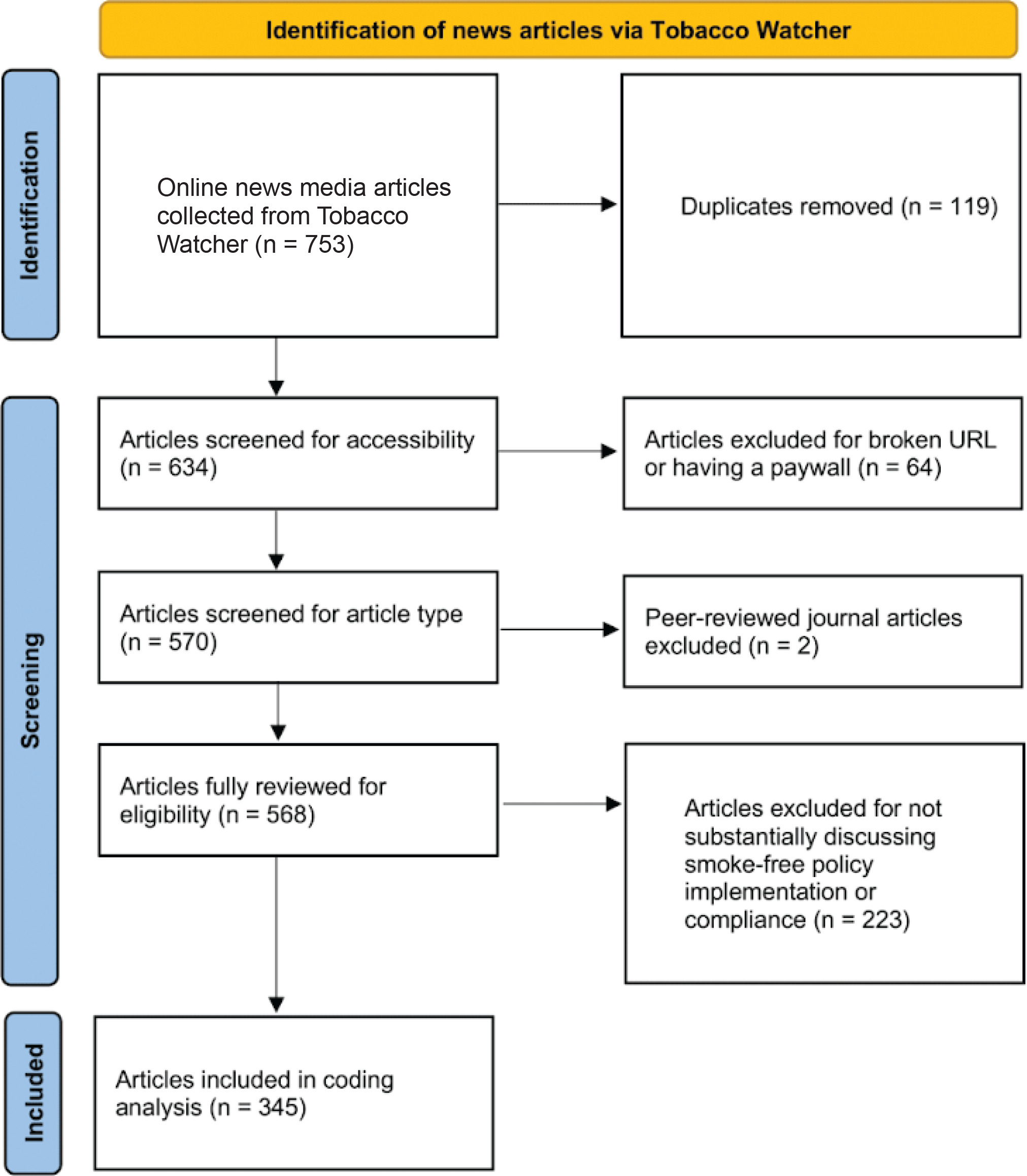
Two trained coders independently assessed all articles for relevance, defined as either featuring more than one paragraph discussing smoke-free policy implementation or taking a clear position on smoke-free policy implementation (e.g. mentioning a specific policy and evaluating its impacts in fighting death/disease). Articles deemed irrelevant (n=223), inaccessible due to broken URLs (n=60) or paywalls (n=4), or identified as research or journal articles (n=2) were excluded from the analysis. This resulted in 345 of the 634 articles meeting the inclusion criteria for evaluation, as outlined in Figure 1.
Figure 1
Flowchart showing the number of online news media articles on smoke-free policy implementation in ten LMICs, March 2022 to September 2023, identified at each stage of the search and screening process
Coders also classified articles by type: news article (a news report written to inform about recent events), feature article (a more creative and less formal article that explores a topic or event in greater depth than a typical news report), or opinion piece (an article written to convey an individual’s perspective on a topic). Google Translate was used to translate nonEnglish articles for content analysis.
A codebook was developed using a combination of inductive and deductive approaches through an iterative process. Codes adapted from prior research utilizing Tobacco Watcher were supplemented by variables based on themes emerged in the data through multiple rounds of preliminary coding20,21.
Articles were evaluated for argument positions and presenters. Variables for argument positions were: 1) supports implementation of existing smoke-free policy, promoting their continued or improved enforcement; 2) discourages implementation of existing smoke-free policy; 3) calls for changes of current policy (such as abolishing provisions allowing designated smoking areas) which suggest the need for stricter smoke-free policies to strengthen tobacco control; 4) calls for changes to current smoke-free policies by proposing a relaxation or reduction in their stringency; 5) successful implementation of smoke-free policy; and 6) unsuccessful implementation efforts for smoke-free policy. An overall argument position variable was coded as present if an article contained any of these argument positions.
Variables for argument presenters were: 1) government, including agencies at local, regional, state or country levels or officials; 2) tobacco companies or industry; 3) healthcare providers and medical professionals; 4) people who consume tobacco; 5) people who do not smoke but are affected by others’ smoking; 6) researchers/experts including professors, universities, and research institutes; 7) specific research study or research studies in general; 8) civil society organizations; and 9) the WHO. Argument presenters were coded as present if the article directly or indirectly referred to statements made by any of these presenters. Further details about each variable and examples can be found in the Supplementary file.
Articles were reviewed independently by two coders and double-coded until reaching an inter-rater reliability of ≥0.80 for all variables. Any disagreements were resolved by extensive discussion with a third coder acting as a reviewer. Coders met routinely to resolve disagreements and discuss codebook revision.
After coding 208 articles in accordance with the final iteration of the codebook, the coders reached an inter-rater reliability of 0.82–0.91 and a prevalenceadjusted kappa of 0.64–0.96 across variables, indicating fair to good agreement (see Supplementary file). The two coders then single-coded the remaining articles. Articles coded before the final codebook iteration (n=184) were recoded to ensure consistency.
Descriptive analysis was performed to obtain frequencies for each variable. Google Forms was used for data management and coding. Descriptive analysis, including frequency counts for each variable, was performed in Google Sheets using built-in functions.
RESULTS
Among the 345 articles assessed, 94.5% were news articles (n=326), 4.3% were op-eds (n=15), and the rest were feature or other article types (n=4) (Table 1); 35.1% (n=121) of the articles were published on Indonesian platforms, 13.6% (n=47) were published in China, 7.2% (n=25) in Vietnam, 13.6% (n=47) in Mexico, 7.8% (n=27) in India, and 7.5% (n=26) in Bangladesh, with the remaining being distributed across Ukraine (9.0%, n=31), Philippines (2.9%, n=10), Pakistan (2.6%, n=9), and Brazil (0.6%, n=2). Most articles supported the implementation of smoke-free policies. Some included statements calling for stricter smoke-free policy and/or mentioned unsuccessful implementation of current policy. Some articles praised current smoke-free policy implementation, and a small portion of articles rejected current smoke-free policy measures and/or suggested relaxing these policies. We observed a variety of authorities presenting arguments, including government officials, WHO and other organizations, researchers, and health experts.
Table 1
Distribution of online news media articles discussing smoke-free policy implementation or compliance, by article type and country, from ten LMICs, March 2022 to September 2023 (N=345)
Of the 345 articles included in this study, most articles (81%, n=278) contained statements supporting the implementation of smoke-free policies. Examples of these statements included those praising government programs that raised awareness for tobacco control policies, promoting collaboration across sectors for tobacco control efforts, and covering awards for successful smoke-free policy implementation. Table 2 shows example quotes for each argument position and presenter.
Table 2
Argument positions discussing smoke-free policy implementation found in online news media articles from ten LMICs, March 2022 to September 2023 (N=345)
Arguments that were frequently presented as reasons for supporting smoke-free policy included protecting youth, eliminating tobacco-related death and disease, protecting tourism interests, upholding the right to breathe smoke-free air, and protecting the environment.
A substantial number of articles included statements calling for stricter smoke-free policy (21.4%, n=74) and statements mentioning unsuccessful implementation of current policy (31.0%, n=107). These articles sometimes argued that despite tobacco policies being sufficiently strict on paper, implementation efforts were weak (‘paper tiger’). Furthermore, many articles covered attempts of tobacco companies and other businesses to take advantage of legislative loopholes. We observed a diverse set of article types and argument presenters (government officials, researchers, civil society organizations such as NGOs, etc.) calling for stricter smoke-free policy.
Discussion attributed suboptimal implementation of law to lack of public awareness, lack of government authority or incentive to enforce legislation, and prevailing cultural norms that result in violations.
We observed articles discussing 100% smoke-free spaces and the abolition of designated smoking areas (DSAs), drawing on scientific evidence and personal anecdotes. Some articles called for a national smoke-free law to supersede regional interests, citing regional disparities in tobacco control implementation. Furthermore, we observed calls to extend current smoke-free policies to additional forms of tobacco.
There were also articles praising existing smoke-free policy implementation, stating it is being carried out well (20.3%, n=70). These articles presented scientific evidence of a decrease in smoking prevalence, awards from organizations or governments (e.g. WHO, Health Ministry), successful events or campaigns, and new tools, mostly seen in stories at a local level.
A small portion of articles rejected current/existing smoke-free policy measures in general (7%, n=24) and suggested altering current smoke-free policies by relaxing their stringency (2.6%, n=9). These articles cited businesses or tobacco industry actors that resisted stringent laws due to economic interests. Other arguments against stronger policies included bribery, and corruption, and taking away the rights of people who smoke.
A wide variety of authorities and entities were used to present arguments. Government agencies, officials, and affiliated organizations were most frequent argument presenters (84.3%, n=291), followed by civil society organizations (36.2%, n=125) and WHO (20.3%, n=80), and then by researchers/experts (18.0%, n=62) and research/studies (15.1%, n=52). Doctors/hospitals (6.7%, n=23) and people who consume tobacco (3.8%, n=13) were also mentioned. The tobacco industry was least cited (1.7%, n=6). Table 3 presents examples in which each argument presenter was used to support claims.
Table 3
Argument presenters discussing smoke-free policy implementation, found in online news media articles from ten LMICs, March 2022 to September 2023 (N=345)
DISCUSSION
In this study, discourse around smoke-free policy implementation in online news media of LMICs has been generally supportive, praising active implementation efforts and complete bans. New smoke-free legislation, awards received for positive implementation, insufficient policy or enforcement efforts, and related scientific findings were among frequently covered topics. Media narratives supporting smoke-free policies were frequently presented by messengers such as government, scientific, and civil society organizations and promoted their collaboration, such as in local expert trainings in Chinese cities. These actors often referenced public health interests, such as eliminating tobacco-caused death and disease, in calling for further enforcement efforts. Online news media articles often referred to populations vulnerable to SHS (e.g. mentioning protecting schools and children’s spaces) in framing smoke-free policy and SHS protection as a moral responsibility.
These findings suggest that media report implementation of smoke-free policies in LMICs mostly in a favorable light, while also discussing implementation challenges. Some articles described insufficient regulatory frameworks, government inaction, and cultural normalization of smoking, citing incidents of smoking violations in public spaces, lacking signage, and complaints from people who do not smoke but are affected by SHS. For instance, in Indonesia, failure of existing tools to monitor implementation data were cited, and in China, parents were found smoking near schools, suggesting normalization of tobacco use. These incidents suggest the critical importance of effective enforcement mechanisms as well as other strategies to enhance compliance.
In line with previous studies on the benefits of increased public engagement in enforcing smoke-free policies, we observed discussion of the potential efforts, such as local task forces and campaigns aimed at raising awareness, in supporting enforcement in LMICs11-13. Furthermore, new and cross-sector enforcement methods may address current issues in implementation. For instance, we observed coverage praising novel digital monitoring technologies, educational youth engagement campaigns, and community surveillance avenues in this sample. Future research should explore new strategies and their effectiveness in reducing SHS exposure, especially in LMICs, including various methods of utilizing media to promote tobacco control.
While a substantial number of city-level, regional wins were mentioned – such as city-level WHO World No Tobacco Day awards in China and governmental awards in Indonesia – articles praising a national law were rare. In some countries, articles discussed how despite lacking implementation, the public generally supported tobacco control policy, leading to good compliance, such as in Ukraine and Vietnam.
In addition to strengthening the implementation of smoke-free legislation, stronger policies are also needed to improve tobacco control in LMICs. One-fifth (21%) of articles in this study called for stricter policies, such as eliminating designated smoking areas and expanding bans to various tobacco and nicotine products, for instance, e-cigarettes and hookahs in Indonesia, Mexico, and Ukraine. These calls align with current literature demonstrating the need for stronger smoke-free policy. Stronger measures include country-specific smoke-free legislation due to varying levels of implementation and compliance and expansion of current policies to address use of electronic cigarettes, as well as other tobacco or nicotine products and industry tactics26.
Many online news media articles framed designated smoking areas (DSAs) as violations to the rights of people who do not smoke to be free from SHS, highlighting their ineffectiveness, lack of enforcement, and low compliance levels. Consistently, complete bans have been demonstrated to be easier to implement than partial bans that allow for DSAs27. Partial bans may fail to adequately protect individuals from SHS, pose organizational challenges, and allow for increased tobacco industry interference26. Media and other actors should advocate for similar nationallevel legislation requiring 100% smoke-free policies to fully protect people from a major cause of health burden.
Although media sentiments against smoke-free policies were less common in this sample, 7% of the articles discouraged smoke-free policy implementation, and 3% advocated for more lenient smoke-free policies. Some of these articles framed smoking and DSAs as essential to a fair market, but these claims are often unsupported by empirical data. Articles also captured tobacco industry efforts to mislead the public and downplay smoke-free policy effectiveness, suggesting online news can reflect harmful industry narratives in LMICs.
Media can be leveraged to amplify scientific evidence in countering narratives of economic loss surrounding smoke-free policies. Proactive dissemination and other strategic communication strategies have been shown to play a crucial role in sustaining policy momentum and discrediting industry-fueled economic arguments, shifting public opinion in favor of tobacco control legislation19,25.
Limitations
The articles in this study cover a limited timeframe (March 2022 – September 2023) and only include 10 LMICs and do not fully capture long-term trends or broader regional variations. There may be other limitations associated with using the Tobacco Watcher tool for identifying articles, such as the scope of media sources included in its surveillance system. Only online news media were analyzed, excluding other sources such as print media, television, radio, and social media, which may also shape public discourse on smoke-free policies. Future research could expand the geographical scope and include a broader range of media formats and data sources such as social media and print sources for improved generalizability.
Furthermore, the online news media articles often provided surface-level coverage, lacking depth or detailed analysis of policy implementation challenges and effectiveness. Variability in the quality and detail of articles can affect the consistency of the media narratives analyzed. In addition, articles published in languages other than English were translated using Google Translate, which may have resulted in uncaptured nuanced meanings in policy discussions.
Ultimately, news media can be utilized as avenues for building public support for policy implementation and new policies and countering tobacco industry narratives. Governments, health organizations, and other public health advocates should leverage media to accessibly communicate tobacco control progress and obstacles.
CONCLUSIONS
This study provides insight into the landscape of online news media articles on smoke-free policy implementation in LMICs in 2022–2023, with most supporting 100% smoke-free public places. While online media reported implementation barriers such as lacking enforcement, insufficient policy, and cultural normalization of smoking, they also highlighted positive impacts of smoke-free law and progress. Smoke-free laws have demonstrated the impacts of encouraging smoking cessation, denormalizing tobacco use, decreasing health risks, and improving economic revenue for businesses and tourism. These outcomes were captured by news narratives that emphasized broader public health and tobacco control goals. Strategic use of news media may serve to amplify evidence and support for such smoke-free policies in LMICs and critically urge governments to pass tobacco control legislation that can save lives.