


INTRODUCTION
Tobacco use remains the leading preventable cause of death in France and is responsible for approximately 13% of avoidable deaths each year1. Yet, smoking reduces life expectancy by an average of 10 years2, and despite this significant impact on public health, 23% of people aged 15–75 years smoked daily in 2023 in France3. Nevertheless, behavioral interventions as well as medications such as nicotine replacement therapy (NRT), varenicline, and bupropion have proven effective to quit4, with NRT and varenicline being covered by the health insurance system. Since 2016, registered nurses in France have been legally authorized to prescribe NRT, without requiring certification or additional training in smoking cessation, but this possibility is rarely used in practice5.
The benefits of involving nurses in smoking cessation support are well documented. A Cochrane review showed that nurse-led interventions increased quit rates by 30% across clinical settings6. Moreover, intensive in-hospital cessation support with NRT prescription offers significant benefits7. Finally, nurses might play a key role in smoking cessation in specialized hospital settings by managing NRT dosing and follow-up care8.
Implementing nurse-led smoking cessation care in hospital settings remains challenging because smoking assessment and cessation support are often not integrated into routine care, owing to competing clinical priorities, limited time, and variable staff training. To address these challenges, a survey was conducted in 2016 at the Georges Pompidou European Hospital (HEGP), a university hospital in Paris, showing that smoking status was recorded in only 30% of patients’ electronic medical records (EMRs)9. Consequently, since 2021, smoking status has been systematically recorded in EMR by nursing staff at admission10. Around 12% of inpatients were smokers in 2023, with 83 individuals present daily among the hospital’s 691 beds. The HEGP addiction center team members, with their Equipe de liaison et de soins en addictologie (ELSA)11, provide bedside counseling to inpatients and recommendations to the medical teams when being contacted by the departments’ staff. Given the smoking prevalence and the short duration of hospital stays, the HEGP addiction center team cannot systematically provide care to every smoker hospitalized in HEGP departments. However, although nurse-led smoking cessation interventions have shown potential benefits, evidence remains limited regarding how to effectively integrate such interventions into routine hospital care and ensure their implementation across different clinical settings. To address this limit, involving nursing teams in daily smoking cessation support within specialized hospital departments appears both necessary for hospitalized smokers at risk of withdrawal symptoms and promising for improving cessation care. This requires empowering nurses with the skills and tools needed to deliver structured smoking cessation support.
Therefore, our research aims to implement a nurse-led smoking cessation intervention by training nurses in smoking cessation care in HEGP hospital, including NRT prescriptions and post-discharge follow-up, to establish sustainable cessation practices within nursing teams. This implementation trial will evaluate both smoking cessation outcomes and implementation outcomes, including nurses’ satisfaction with the intervention, the uptake of NRT prescriptions, and the integration of this approach into routine clinical practice over time.
METHODS
NICOTINURSE is designed as a stepped-wedge cluster randomized trial. The protocol was developed in accordance with the CONSORT statement, including its extension for stepped-wedge cluster randomized trials12,13. The protocol development was also guided by the recommendations of the SPIRIT checklist14.
Study description
NICOTINURSE trial will be conducted across four departments: intensive care cardiology unit (ICCU)/cardiology department, nephrology department, pulmonology department, and arterial hypertension/vascular medicine (AH/VM) department. These departments were selected because smoking is a risk factor among their patients’ populations, making nurse-led intervention particularly relevant.
Stepped-wedge cluster randomized trial design
NICOTINURSE is an open, cluster-randomized, stepped-wedge trial. In this design, departments represent 4 clusters, corresponding to nurse teams of each department. At the start of the study, no team will benefit from training. Every 5 months, a team will be trained, with the training taking place over a 2-week period. Once a team is trained, the department remains in the experimental group until the study ends. The order in which departments undergo training will be randomized. This design consists of five time periods, including a baseline period corresponding to usual care in the 4 departments (Figure 1).
Figure 1
Stepped-wedge cluster randomized design of the NICOTINURSE trial, September 2025–April 2028. The study will be conducted at Georges Pompidou European Hospital (HEGP), Paris, France, across 4 departments: the Intensive Care Unit (ICCU)/Cardiology department, Nephrology department, Pulmonology department, and Arterial Hypertension/Vascular Medicine (AH/VM) department
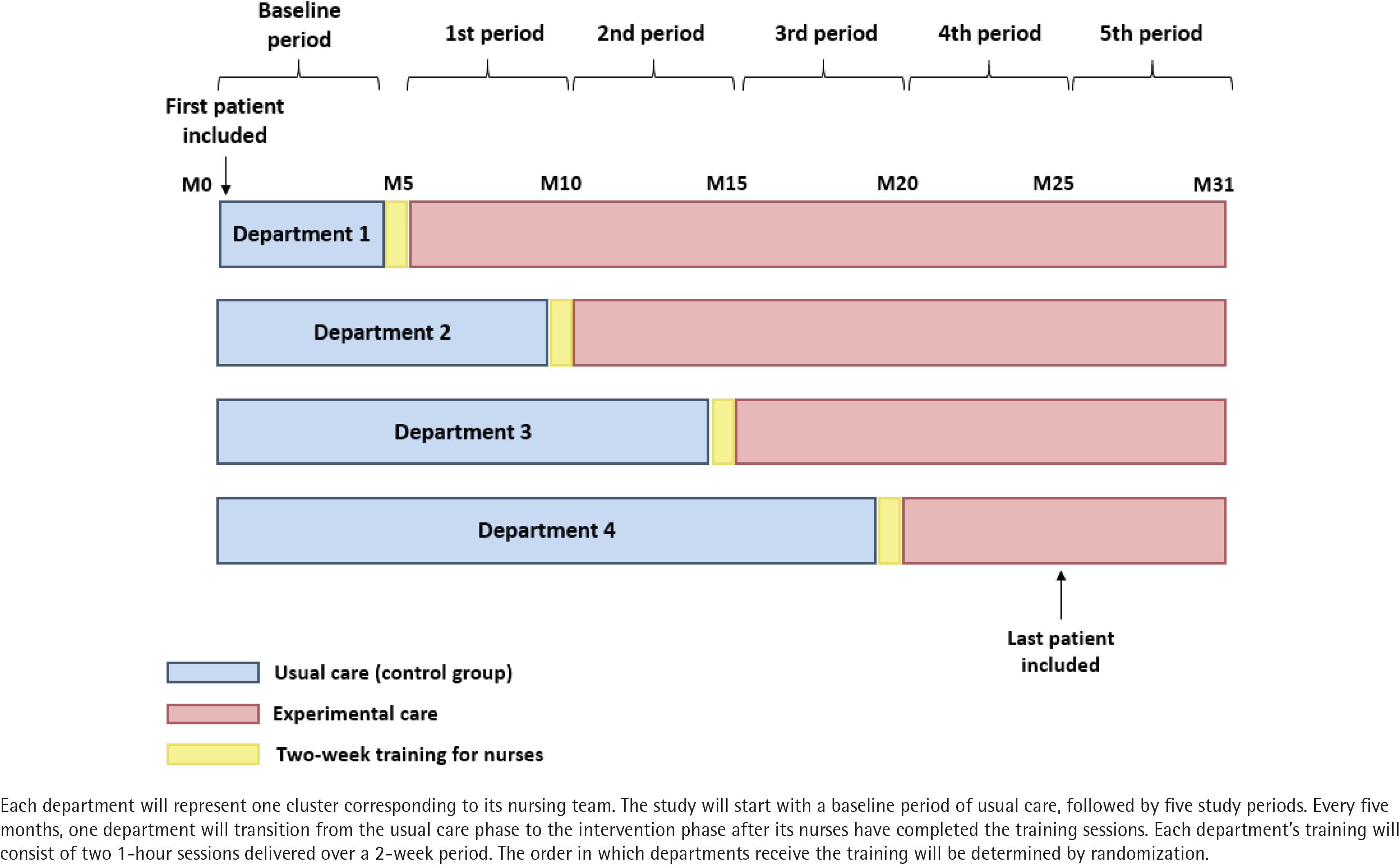
The stepped-wedge design was chosen to minimize contamination bias between trained and untrained nurses within the same department, as all departments eventually receive the intervention.
The order in which departments undergo training will be determined using a randomization sequence generated with SAS software15 by a statistician blinded to the identity of the departments. The randomization sequence will be securely stored by the study sponsor (AP-HP). Owing to the nature of the intervention, blinding of nurses, participants, and outcome assessors is not feasible. However, outcome assessors (the scientific research coordinator [ALLF], the research assistant [AS], and the replacement research assistant) can remain blinded from the first study period onwards, as outcomes and secondary endpoints are based on participant-reported measures and objective measurements (expired CO), rather than on the smoking-cessation care delivered or the department in which participants were hospitalized.
Usual care
The usual care, when provided, is either coordinated by ELSA, reachable via a dedicated phone number, or provided by medical doctors of each specialized department. The ELSA members document the EMR on smoking behaviors16, prescribe NRT during hospital stay as well as upon discharge, and arrange post-discharge referrals (addiction centers, ambulatory health professionals or national quit line)17.
Description of intervention
During the NICOTINURSE study, nurses from the 4 departments will be trained in smoking cessation care, according to the study’s five periods (Figure 2). The training will be delivered by the scientific research coordinator (ALLF), a member of the HEGP addiction center team.
Figure 2
Schedule of the two-week nurse training period in the NICOTINURSE stepped-wedge cluster randomized trial
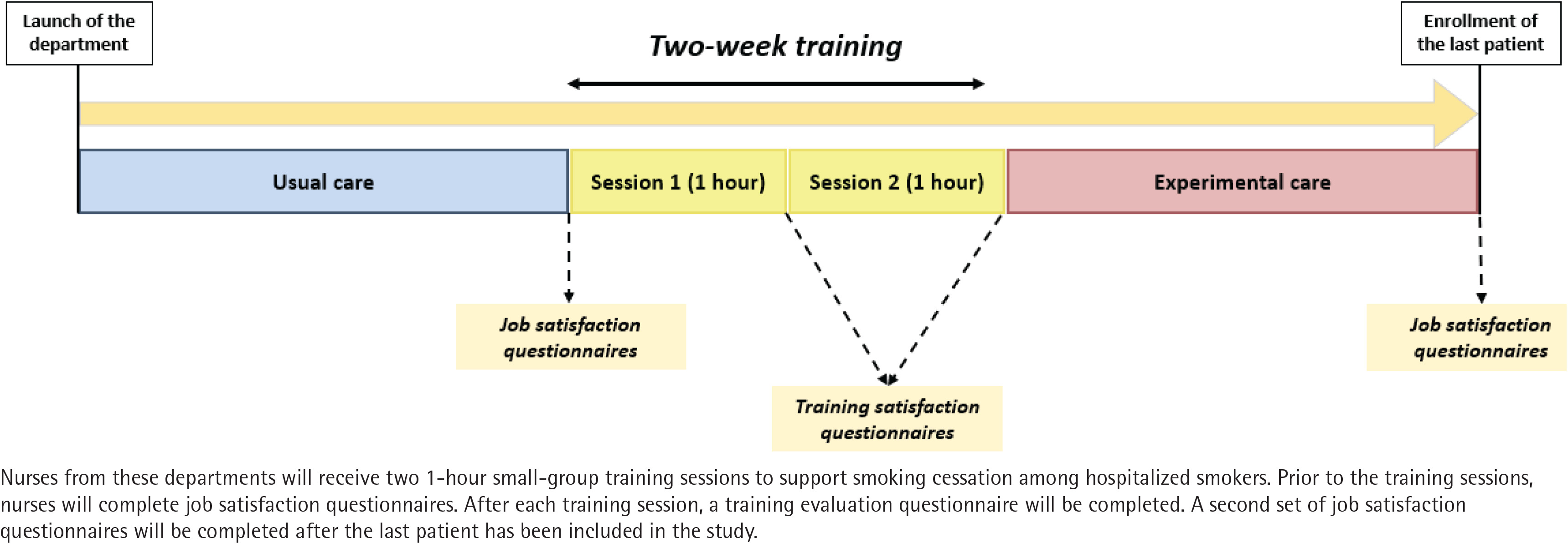
The 4 nursing teams will undergo two one-hour training sessions, delivered in small groups, to facilitate interaction.
Nurses will be equipped with the skills necessary to communicate with the smoker, such as motivational tools and a non-judgmental way of questioning smokers18, informing on NRT use and adapted doses19, as well as arranging follow-up17. Table 1 details the training sessions’ contents. Successful completion of the training will be assessed by attendance at both sessions and completion of a training evaluation questionnaire. Following completion of the training, access to NRT prescription through the EMR will be authorized by the IT team. During the initial implementation phase, the addiction center team will support nurses with the first NRT prescriptions. Prescription data and smoking cessation support delivered by nurses will be monitored through the EMR.
Table 1
Nurse training workshops* that will be delivered as part of the NICOTINURSE stepped-wedge cluster randomized trial to support smoking cessation in hospitalized smokers. Training will be implemented sequentially according to the randomized stepped-wedge schedule during the first two weeks of February 2026, July 2026, December 2026, and May 2027
| Session | Training program outline | Instructors | Deliverables |
|---|---|---|---|
| 1 |
| Addiction Center: the scientific research coordinator (ALLF) and the research assistant (AS) | Minnesota Job satisfaction questionnaire23 Training validation form |
| 2 |
| Addiction Center (ALLF, AS) | Training documents including additional videos for night-shift staff Training validation form |
* The workshops will take place in four departments at Georges Pompidou European Hospital (Paris, France): the Intensive Care Cardiology Unit (ICCU)/Cardiology, Nephrology, Pulmonology, and Arterial Hypertension/Vascular Medicine (AH/VM) departments. Approximately 50 registered nurses will attend two 1-hour small-group training sessions delivered over a 2-week period by the scientific research coordinator (ALLF). CO: carbon monoxide; NRT: nicotine replacement therapy. HEGP: Georges Pompidou European Hospital. HIS: heaviness of smoking index. EMR: electronic medical records.
Participants
Eligibility criteria
The study population consists of current smokers, defined as people with active tobacco use20, hospitalized in the participating HEGP departments. Eligible participants will be identified through systematic smoking status assessment at admission by nurses. In cases where smoking status has not been recorded, the research assistant will screen the list of patients recently admitted to identify potential smokers and will inform the nurses, who will approach eligible patients and propose study participation.
Eligible participants are adult patients hospitalized in one of the participating departments, identified as current smokers, residing in the Île-de-France region, and able to provide informed consent. Patients not affiliated with the French national health insurance system, under legal protection, pregnant or breastfeeding women, or those meeting other predefined exclusion criteria are not eligible. Detailed inclusion and exclusion criteria are described in Table 2.
Table 2
Inclusion and exclusion criteria for hospitalized adult smokers eligible for participation in the NICOTINURSE stepped-wedge cluster randomized trial
Primary outcome
The primary outcome is defined as one-month abstinence after hospital discharge that captures the high risk of early relapse and is a strong predictor of long-term abstinence, increasing fivefold after the first four weeks of abstinence21. Abstinence is defined as no tobacco use in the 7 days preceding the follow-up visit. Smoking status will be biochemically verified in all participants at 1, 3, and 6 months after hospital discharge using exhaled carbon monoxide (CO), with abstinence confirmed by a CO level of ≤10 parts per million (ppm)22.
Secondary outcomes
Secondary outcomes include both smoking-related and psychosocial measures to evaluate the impact of the intervention at 1, 3, and 6 months after discharge (Table 3). The nurses’ job satisfaction score23 is completed before training and at the study end (Table 1).
Table 3
Study outcomes assessed at 1, 3, and 6 months after hospital discharge in the NICOTINURSE stepped-wedge cluster randomized trial evaluating nurse-led smoking cessation support among hospitalized smokers, September 2025 – April 2028
[i] Participants will be recruited from four departments at Georges Pompidou European Hospital (Paris, France): the Intensive Care Cardiology Unit (ICCU)/Cardiology, Nephrology, Pulmonology, and Arterial Hypertension/Vascular Medicine (AH/VM) departments. All data collection procedures, including questionnaire administration and CO measurement during study visits, performed by the research assistant. CO: carbon monoxide; NRT: nicotine replacement therapy. HEGP: Georges Pompidou European Hospital. HIS: heaviness of smoking index. EMR: electronic medical records. SF-12 questionnaire: Quality of life questionnaire.
Harms
Adverse events potentially related to NRT will be systematically recorded throughout the study. Expected adverse events include skin reactions at the patch application site, insomnia, headache, gastrointestinal disorders (including abdominal pain, nausea, vomiting, and bowel disturbances), dry mouth, muscle pain, and any other reported symptoms. Each adverse event will be documented using a dedicated adverse event form and managed according to standard clinical practice. Given the well-established safety profile of NRT, no specific serious adverse events related to the intervention are anticipated. However, any adverse event reported during the study will be recorded.
Participant timeline
At the time of inclusion (initial visit, V0), the study will be presented to the patient by an investigator, nurse or medical doctor, and the patient will be given time to provide written informed consent. For women of childbearing age, a pregnancy test will be performed to confirm eligibility. On the day of inclusion, demographic characteristics, medical history, and smoking behaviors will be collected. Self-administered questionnaires, the SF12 quality of life24 and the Hospital Anxiety and Depression scale (HAD), will also be provided to the smoker25, with the exhaled CO measure being performed. In the control group, patients will receive usual care. In the experimental group, smokers will receive counseling from trained nurses on NRT forms in order to determine the most suitable option to be prescribed during hospital stay and at discharge. NRT will be prescribed through the hospital’s electronic prescribing system and recorded in the patient’s EMR. The prescribed NRT will be retrieved from the automated medication dispensing cabinet available in each department and provided to the patient during the hospital stay.
At discharge (V1), patients will receive an NRT prescription for a one-month period with a dosage adjustment guide and a dedicated brochure ‘Tobacco, not for me!’.
Patients will return for follow-up visits at 1 (V2), 3 (V3), and 6 months (V4). To minimize loss to follow-up, participants will receive reminders before each scheduled visit, and follow-up appointments will be adapted according to patients’ availability. If a visit cannot be performed in person, patients will be contacted by phone to complete the follow-up assessment remotely. Table 4 outlines the content of these visits.
Table 4
Participant timeline of visits (V0–V4) for hospitalized smokers included in the NICOTINURSE stepped-wedge cluster randomized trial, September 2025 – April 2028
[i] A compensation payment of €30 will be paid to the patient for follow-up consultations. Participants will be recruited from four departments at Georges Pompidou European Hospital (Paris, France): the Intensive Care Cardiology Unit (ICCU)/Cardiology, Nephrology, Pulmonology, and Arterial Hypertension/Vascular Medicine (AH/VM) departments. HEGP: Georges Pompidou European Hospital. HAD: Hospital Anxiety and Depression score. CO: carbon monoxide.
Sample size
Based on prior studies on smoking cessation in hospitalized patients26, the expected one-month abstinence rate would reach 15% in the control group and 30% in the intervention group. Based on a Wald Z-test, and assuming a two-sided alpha of 0.05, 80% power, and an intraclass correlation coefficient27 of 0.3, the estimated required sample size is 420 patients. Accounting for a 5% loss to follow-up, the final target sample size is 442 patients.
Each cluster will enroll about 111 patients over the study. With time periods set at 5 months each, the recruitment phase would span 25 months. Including a 6-month follow-up per patient and additional time for data analysis and reporting, the study duration is estimated at 36 months.
Feasibility of the study
At least ten smokers are expected to be admitted weekly in the 4 departments, based on a preliminary review of smoking status data recorded in the EMR of patients admitted to these departments. Assuming about half to provide consent to participate, the recruitment capacity should be adequate to achieve the target sample size within the planned timeline.
Data collection and analyses
Data from smokers who provide informed consent will be documented in an electronic case report form (eCRF) via CLEANWEB, while data concerning nurses will be recorded in another eCRF. Data entry will be performed by the research assistant. Data will be coded using unique participant identification numbers. Access to the database will be restricted to authorized study personnel, and data will be stored securely according to institutional and regulatory requirements. Data quality will be ensured through regular monitoring procedures, including verification of data completeness and consistency, and review of missing or inconsistent data.
All analyses will be performed according to the intention-to-treat principle, with participants analyzed according to the intervention period of their department at the time of inclusion. Missing data will be described, and analyses will be performed using available data. If the proportion of missing data is substantial, appropriate sensitivity analyses will be considered. Statistical analyses will be performed using SAS version 9.4 (SAS Institute, Cary, NC, USA) or R software (R Foundation for Statistical Computing, Vienna, Austria)15. A two-sided significance level of 0.05 will be used.
Ethics and confidentiality
Ethics approval
The research protocol has been approved by the French ethics committee CPP Nord Ouest I in 2024 (Approval number: 24.03798.000318) and was registered at ClinicalTrials.gov (NCT06789536). Any substantial protocol amendments will be submitted to the ethics committee for review and approval before implementation. Approved amendments will be communicated to all study personnel and documented in the study records.
Confidentiality
All study data will be pseudonymized to protect participants’ confidentiality.
DISCUSSION
The benefits of smoking cessation are established, in terms of improving quality of life, disease evolution, and psychological indicators. For patients, additional benefits might include greater comfort when attempting to quit, associated with NRT use during hospital stay and after discharge28, as well as enhanced support to enable them to stop smoking and avoid early relapse.
For nurses, the training would allow them to gain new skills, prescribe autonomously, and enhance their decision-making latitude. The potential impact of the intervention on nurses’ work experience will be assessed using a job satisfaction questionnaire administered before the training and after inclusion of the last patient. To facilitate implementation despite competing clinical priorities, nurses will be supported by the research assistant when needed. When nurses are unable to prescribe NRT, they will seek support from ELSA.
CONCLUSIONS
At hospital level, this intervention could contribute to the implementation of nurse-led NRT prescription in other departments, improving access to cessation support and enhancing health outcomes and quality of life for inpatients. Integrating this model into routine nursing practice would also ensure better continuity of care post-discharge.