

INTRODUCTION
Electronic cigarettes (e-cigarettes) are devices that generate an inhalable aerosol by electrically heating a liquid1. Since their introduction, these products have diversified from early ‘cig-a-like’ models into vape pens, mods, pod systems, and disposable devices that differ in design, power, liquid capacity, and nicotine delivery2.
Modern e-cigarettes were developed in 2003 by the Chinese pharmacist Hon Lik and first commercialized in China in 2004, and subsequently entered European and United States markets3. E-cigarettes have been used as smoking-cessation aids and proposed as potentially less harmful alternatives to combustible cigarettes4. However, concerns have increased because of emerging evidence of adverse health effects and their uptake among non-smokers, particularly young people1.
Despite a decline in global tobacco use, more than 100 million people worldwide currently use e-cigarettes5. Use is especially common in the World Health Organization (WHO) European Region, where the prevalence of use is estimated at 4.6% among adults and 14.3% among adolescents aged 13–15 years5. Increasing use among young people may undermine progress in tobacco control6. In response, the WHO has called for stronger regulation of e-cigarette promotion, accessibility, and product characteristics to protect children, adolescents, and non-smokers7.
Today, digital platforms have become important sources of health information. YouTube, owing to its large user base and video-based format, is frequently used to obtain health-related information8,9. The platform allows healthcare professionals and institutions, commercial organizations, content creators, and personal users to reach large audiences. However, this open structure also facilitates the dissemination of misinformation and disinformation, which are recognized as major global health risks10. Moreover, popularity indicators such as views, likes, and comments do not necessarily reflect the scientific accuracy, reliability, or quality of the information presented11.
This problem concerning the rapid spread of false and misleading health information became more visible during the COVID-19 pandemic. The pandemic markedly affected how individuals accessed health information and their reliance on digital platforms12,13. The increased uncertainty and need for information during the pandemic also intensified individuals’ behavior on seeking health information. Social media, an important platform for the dissemination of health information, became one of the leading sources through which users obtained health information during this period14. While social media facilitated the rapid dissemination of information related to the pandemic, it also enabled unverified or misleading information to reach wide audiences. As a result, the information crisis referred to as the ‘infodemic’ became more prominent13.
Given the widespread use of YouTube as a source of health information, studies directly comparing e-cigarette-related videos across clearly defined pre- and post-pandemic periods appear to be limited. Evaluating content stance, information adequacy, reliability, and quality together across these periods may provide a broader understanding of differences in e-cigarette-related content between distinct temporal contexts.
This study aimed to compare the content stance, information adequacy, reliability, and quality of e-cigarette- and vaping-related YouTube videos uploaded during the pre- and post-pandemic periods and to identify video characteristics independently associated with the provision of useful information.
METHODS
Study design and study periods
This study was a comparative cross-sectional, video-based content analysis, in which the videos on e-cigarette/vaping available on YouTube were compared between the pre-pandemic and post-pandemic periods. No human participants were included in the study, and the unit of analysis was YouTube videos.
In this study, to compare the quality of e-cigarette-related content on YouTube between the pre- and post-pandemic periods, videos were grouped into two timeframes. These timeframes were defined according to key milestones announced by the WHO. The pre-pandemic period (11 March 2019 – 11 March 2020) comprised the one-year period preceding the WHO’s declaration of COVID-19 as a global pandemic on 11 March 2020, whereas the post-pandemic period (5 May 2023 – 5 May 2024) comprised the one-year period following the end of COVID-19 as a Public Health Emergency of International Concern on 5 May 202315,16. The intervening period between these two reference points was excluded to allow comparison of two distinct one-year periods before and after the pandemic interval.
Sample selection
YouTube searches were conducted during a single data-retrieval session using the YouTube Data API v3. Searches were performed separately using the keywords ‘e-cigarette’ and ‘vaping’ for each predefined study period. Publication-date filters were applied to identify videos uploaded between 11 March 2019 and 11 March 2020 for the pre-pandemic period and between 5 May 2023 and 5 May 2024 for the post-pandemic period.
For each keyword–period combination, 100 videos were selected: the 50 most-viewed videos identified using the API’s viewCount ordering parameter and 50 additional videos selected using a Python-based random sampling procedure. Accordingly, 200 videos were selected for each study period, yielding an initial sample of 400 videos for eligibility assessment.
Duplicate records retrieved through different keyword searches were identified and excluded during the screening process. Videos were eligible when they were in English or had English subtitles, were directly related to e-cigarettes or vaping, and lasted at least one minute. Videos were excluded if they were not in English and did not include English subtitles, if the content was unrelated to e-cigarettes or vaping, or if the video duration was shorter than one minute. Duplicate videos and videos inaccessible, deleted, or unable to be opened due to technical reasons were also excluded.
The predefined inclusion and exclusion criteria were subsequently applied, and 240 eligible videos were included in the final analysis. The video selection process is presented in Figure 1.
Figure 1
Flowchart of video selection in a comparative cross-sectional content analysis of e-cigarette- and vaping-related YouTube videos from the pre-pandemic (11 March 2019 – 11 March 2020) and post-pandemic (5 May 2023 – 5 May 2024) sampling periods (N=400 screened; N=240 included)
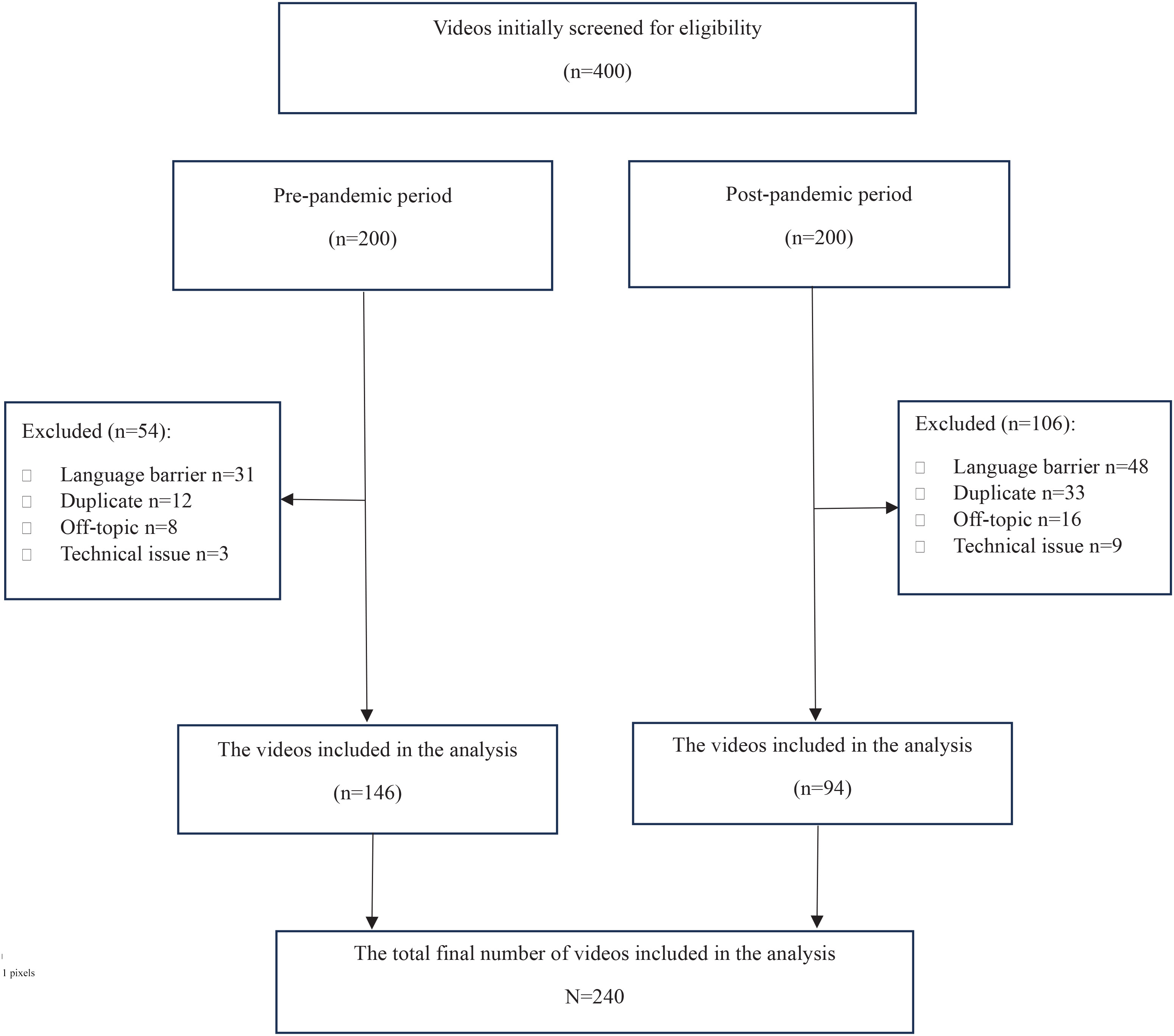
Because YouTube search results are dynamic and may vary according to platform availability and API behavior, the same search may not yield an identical video pool at a later date. The combined use of highly viewed and randomly selected videos was intended to broaden the sample beyond only the most popular content.
Data collection and video characteristics
For each video included in the study, the video title, upload date, and video duration were recorded. To assess the popularity and user interaction characteristics of the videos; the numbers of views, likes, comments, and channel subscribers displayed at the time of evaluation were recorded. Numerical metrics related to the videos were recorded within the same data collection process, since view and interaction values on YouTube can change over time.
Video content classification
The videos were classified according to three separate classification domains: the main topic, the profile of the content uploader, and the stance toward e-cigarette use. These classifications were performed independently of one another.
Main topic
The videos were assigned to one of the following three main topic categories based on their predominant content: personal experience, entertainment, or commercial content; regulation, campaign, or public service announcement; and health effects of e-cigarettes. When a video contained more than one topic, the topic that accounted for the largest proportion of the video’s duration and reflected its main message was considered the primary topic.
Uploader profile
The videos were classified into four groups based on uploader profile and primary area of activity of the uploading channel: personal channels; news channels, podcast channels, or media organizations; commercial content, brands, or advertising channels; health professionals (e.g. physicians), healthcare institutions (e.g. hospitals, universities), and health channels (providing health information without professional medical credentials).
Video stance
The stance of the videos was classified into two categories, pro-vaping and anti-vaping, based on the video’s dominant message.
Pro-vaping content
Videos that directly or indirectly encouraged e-cigarette use, emphasized its positive aspects, presented the product as attractive or preferable, or disregarded or downplayed the risks associated with its use were classified in this category. Sponsored product promotions, content encouraging viewers to purchase e-cigarette products, product reviews presenting e-cigarette use in an appealing manner, and videos emphasizing the social or recreational aspects of use were also classified as pro-vaping.
Anti-vaping content
Videos that did not support e-cigarette use or recommended its cessation, and that emphasized health harms, the risk of nicotine dependence, societal effects, or the necessity of regulatory measures, were evaluated in this category.
Evaluation on adequacy of information provided
The adequacy of information provided in the videos was evaluated in two categories: inadequate/misleading information provided, and useful information provided.
Inadequate/misleading information provided
Videos that did not provide verifiable information about e-cigarettes or vaping; contained only personal experiences, entertainment, or product demonstrations; included scientifically inaccurate, misleading, unverified, or medically invalid claims; or presented substantially incomplete or decontextualized information, were classified in this category.
Useful information provided
Videos that contained relevant, understandable, and verifiable information about e-cigarettes or vaping; whose key messages were consistent with current medical guidelines, recommendations from official health organizations, or reliable academic evidence; and that did not contain significant information errors likely to mislead the user, were evaluated in this category.
Evaluation of video quality and reliability
The Journal of the American Medical Association (JAMA) benchmark criteria and the Global Quality Score (GQS) criteria were used to evaluate the quality and reliability of the videos17. Each of the four JAMA benchmark components was scored as 1 when the criterion was met and 0 when it was not met, yielding a total score ranging from 0 to 4. Scores of 0–1 were classified as low quality, a score of 2 as moderate quality, and scores of 3–4 as high quality. The four components were:
Authorship: clear and credible identification of the content author
Attribution: all information supported by valid references
Currency: information is up-to-date and consistent with recent medical advances
Disclosure: transparency regarding conflicts of interest or sponsorship
The GQS, videos were assigned a score ranging from 1 to 5 according to the extent to which they met the criteria described below. Scores of 1–2 were classified as low quality, a score of 3 as moderate quality, and scores of 4–5 as high quality18.
Poor quality: information missing, technique misleading; unlikely to be useful for patient education
Generally sparse quality: some information provided but majority lacking, technique poor, limited use for patients
Moderate quality: important information provided but some lacking, technique mostly adequate; somewhat useful for patients
Good quality: majority of information provided but some information lacking, technique adequate; useful for patients because most important topics are covered
Excellent quality: full information provided; technique adequate; highly useful for patients
Reviewer assessment and adjudication
The videos included in the study were independently evaluated by two physicians who were specialists in family medicine. The reviewers separately coded the videos’ content stance, adequacy of information provided, JAMA score, and GQS score according to predetermined evaluation criteria. No formal pre-coding training or calibration exercise was conducted.
Videos for which the two reviewers disagreed in at least one of the four evaluation domains – content stance, adequacy of information, JAMA category, or GQS category – were subsequently assessed by a third physician, who was blinded to the initial ratings, to resolve the discrepancies. The final classifications and scores established after third-reviewer adjudication were used in the main statistical analyses. All three physicians had clinical experience working in smoking-cessation clinics and providing tobacco-dependence counseling.
Statistical analysis
Statistical analyses were performed using IBM SPSS Statistics for Windows, version 25.0 (IBM Corp., Armonk, NY, USA). Categorical variables are presented as frequencies and percentages, whereas numerical variables were summarized using the median and interquartile range (IQR=Q3-Q1). The distributions of numerical variables were assessed using the Kolmogorov–Smirnov test. Because the numerical variables were not normally distributed, the Mann–Whitney U test was used to compare two independent groups.
Inter-rater agreement for content stance, adequacy of information provided, JAMA category, and GQS category was assessed using unweighted Cohen’s kappa statistic, and κ values were interpreted according to the criteria proposed by Landis and Koch.
Associations between categorical variables were evaluated using Pearson’s chi-squared test when the test assumptions were met. Fisher’s exact test was used for 2×2 contingency tables with low expected cell counts, whereas the Fisher–Freeman–Halton exact test was used for larger contingency tables. When the overall comparison of a variable with more than two categories was statistically significant, category-specific proportions were compared using pairwise z tests with Bonferroni correction.
Multivariable binary logistic regression analysis was performed to identify factors independently associated with the useful information provided from the videos. The dependent variable was coded as 1 for useful information and 0 for misleading or inadequate information. Upload period, video stance, main topic, and uploader profile were selected a priori according to the study objectives and theoretical relevance and were entered simultaneously into the model.
The reference categories were the post-pandemic period for upload period, anti-vaping for video stance, health effects for main topic, and healthcare professionals, healthcare institutions, or health-information channels for uploader profile. The results are presented as adjusted odds ratios (AORs), 95% confidence intervals (CIs), and p-values. The explanatory power of the model was reported using the Nagelkerke pseudo-R2 value. All statistical tests were two-sided, and p<0.05 was considered statistically significant.
Ethical considerations
This study analyzed publicly accessible YouTube videos and did not involve human participants or intervention, access to private accounts, or the use of identifiable personal health data. Only publicly available video- and channel-level information was collected, and privacy, copyright, and research-integrity principles were observed throughout the study. As there was no interaction with users, access to private accounts, or collection of identifiable personal health data, formal ethics committee or institutional review board approval or exemption, was not sought.
RESULTS
Video selection and inter-rater agreement
A total of 400 videos were initially assessed for eligibility, 240 videos were included in the final analysis. Inter-rater agreement was almost perfect for content stance (κ=0.825, p<0.001), substantial for the adequacy of information provided (κ=0.795, p<0.001), substantial for the JAMA benchmark criteria (κ=0.619, p<0.001), and substantial for the GQS assessments (κ=0.616, p<0.001). The two reviewers disagreed in at least one assessment domain for 109 of the 240 videos (45.4%).
General analysis of all videos
Regarding the main topic, 106 videos (44.2%) featured personal experience, entertainment, or commercial content, 100 (41.7%) focused on health effects, and 34 (14.2%) addressed regulation, campaigns, or public service announcements. Regarding uploader category, 81 videos (33.8%) were uploaded by personal users, 81 (33.8%) by news, podcast, or media organizations, 48 (20.0%) by health professionals, healthcare institutions, or health-information channels, and 30 (12.5%) by commercial content, brands, or advertising channels.
With respect to content stance, 145 videos (60.4%) were classified as anti-vaping, whereas 95 (39.6%) as pro-vaping. Regarding the adequacy of information provided, the videos were equally distributed between those providing adequate information and those providing inadequate or no information (n=120; 50% for each group).
According to the JAMA benchmark criteria, 147 videos (61.3%) were classified as low, 67 (27.9%) moderate, and 26 (10.8%) high category. According to the GQS, 173 videos (72.1%) were classified as low, 40 (16.7%) moderate, and 27 (11.3%) high quality.
There were no statistically significant differences between pro-vaping and anti-vaping videos in terms of the number of views, likes, comments, or video duration (p>0.05). However, the channels uploading anti-vaping videos had significantly more subscribers than those uploading pro-vaping videos (p<0.001).
There were no statistically significant differences between videos providing useful information and those providing inadequate or no information with respect to the number of views, likes, comments, or video duration (p>0.05). However, the channels uploading videos classified as providing useful information had significantly more subscribers than those uploading videos classified as providing inadequate or no information (p<0.001).
The majority of pro-vaping videos (94.7%, n=90) were classified as providing inadequate or no information, whereas this proportion was 20.7% (n=30) among anti-vaping videos. The difference was statistically significant (p<0.001).
Analysis of the included videos by pre- and post-pandemic periods
Of the 240 videos analyzed, 146 (60.8%) were uploaded in the pre-pandemic period and 94 (39.2%) in the post-pandemic period. Video stance did not differ significantly between periods (p>0.05), with anti-vaping videos accounting for 63.7% (n=93) of pre-pandemic and 55.3% (n=52) of post-pandemic videos. There were also no differences between the periods in the numbers of views, likes, comments, and channel subscribers (all p>0.05), whereas video duration was longer in the post-pandemic period (p=0.040) (Table 1).
Table 1
Comparison of video characteristics between the pre-pandemic (11 March 2019 – 11 March 2020) and post-pandemic (5 May 2023 – 5 May 2024) periods in a comparative cross-sectional content analysis of e-cigarette- and vaping-related YouTube videos (N=240)
Useful information was less frequent in the post-pandemic period than in the pre-pandemic period (36.2%, n=34 vs 58.9%, n=86; p=0.001) (Table 1). The distribution of GQS categories did not differ significantly between periods (p=0.184), whereas the distribution of JAMA categories differed significantly (p=0.019). The low JAMA category was more frequent in the post-pandemic period than in the pre-pandemic period (71.3% vs 54.8%), whereas the moderate category was less frequent (18.1% vs 34.2%); the high category was similarly represented in the two periods (10.6% vs 11.0%). Bonferroni-adjusted post hoc comparisons showed significant differences between periods in the low and moderate JAMA categories, but not in the high JAMA category.
A statistically significant difference was also observed in video uploader categories between periods (p<0.001). Personal-user uploads were more frequent in the post-pandemic period than in the pre-pandemic period (51.1% vs 22.6%; Bonferroni-adjusted p<0.001), whereas news/podcast uploads were less frequent (24.5% vs 39.7%; adjusted p=0.015); no significant between-period differences were observed in the remaining uploader categories. Main topic also differed between periods (p=0.006), primarily because of changes in personal experiences, entertainment, or commercial content, as well as those focusing on regulation, public campaigns, or public service announcements. Personal experience, entertainment, or commercial content was more frequent in the post-pandemic period than in the pre-pandemic period (56.4% vs 36.3%; adjusted p=0.002), whereas regulation, campaign, or public service announcement content was less frequent (8.5% vs 17.8%; adjusted p=0.044).
Comparison according to adequacy of information provided
Table 2 presents the comparison of adequacy of information provided with other study variables in videos published during the pre- and post-pandemic periods.
Table 2
Comparison of information adequacy with other study variables in a comparative cross-sectional content analysis of e-cigarette- and vaping-related YouTube videos, pre-pandemic (11 March 2019 – 11 March 2020) and post-pandemic (5 May 2023 – 5 May 2024) periods (N=240)
A statistically significant difference was observed between video content stance and the adequacy of information provided in both the pre- and post-pandemic periods (p<0.001). In both periods, the proportion of videos providing inadequate or no information was significantly higher among pro-vaping videos than among anti-vaping videos.
The distribution of JAMA categories differed significantly according to information adequacy in both the pre- and post-pandemic periods (p<0.001 for both). In the pre-pandemic period, Bonferroni-adjusted post hoc comparisons showed that the proportion of videos classified in the low JAMA category was significantly higher among videos providing inadequate or no information (adjusted p<0.001). Videos providing useful information were significantly more likely to be classified in the moderate JAMA category (adjusted p<0.001) and the high JAMA category (adjusted p=0.008).
Similarly, in the post-pandemic period, the low JAMA category was significantly more frequent among videos providing inadequate or no information (adjusted p<0.001), whereas the moderate (adjusted p=0.001) and high JAMA categories (adjusted p<0.001) were significantly more frequent among videos providing useful information.
When the GQS distributions were analyzed, all videos providing inadequate or no information were classified in the low GQS category in both periods (n=60; 100% in each period). Among videos providing useful information, 39 (45.3%) were classified as low, 28 (32.6%) moderate, and 19 (22.1%) high GQS in the pre-pandemic period; the corresponding numbers in the post-pandemic period were 14 (41.2%), 12 (35.3%), and 8 (23.5%), respectively.
Comparison according to video content stance
Table 3 presents the comparison of video content stance with other variables in videos published during the pre- and post-pandemic periods.
Table 3
Comparison of video content stance with other study variables in a comparative cross-sectional content analysis of e-cigarette- and vaping-related YouTube videos, pre-pandemic (11 March 2019 – 11 March 2020) and post-pandemic (5 May 2023 – 5 May 2024) periods (N=240)
| Variables | Pre-pandemic (N=146) | Post-pandemic (N=94) | ||||
|---|---|---|---|---|---|---|
| Pro-vaping (N=53) | Anti-vaping (N=93) | p | Pro-vaping (N=42) | Anti-vaping (N=52) | p | |
| Popularity and interaction metrics, median (IQR) | ||||||
| Number of views | 100355 (1054669.50) | 42263 (664628.50) | 0.122 | 22620 (634400) | 738684 (1733289.75) | <0.001 |
| Number of likes | 1272 (15017) | 268 (8041.50) | 0.045 | 176.5 (9351.25) | 11818 (45671) | <0.001 |
| Number of comments | 177 (673.50) | 43 (816) | 0.328 | 25 (380.25) | 577 (2788) | 0.001 |
| Video duration (minutes) | 5.42 (7.63) | 3.40 (4.38) | 0.135 | 7.71 (11.49) | 7.81 (12.36) | 0.915 |
| Number of channel subscribers | 49200 (446250) | 452000 (1381950) | <0.001 | 18050 (135624.50) | 533000 (3149500) | <0.001 |
| JAMA, n (%) | ||||||
| Low | 47 (88.7) | 33 (35.5) | <0.001 | 39 (92.9) | 28 (53.8) | <0.001 |
| Moderate | 5 (9.4) | 45 (48.4) | 3 (7.1) | 14 (26.9) | ||
| High | 1 (1.9) | 15 (16.1) | 0 (0) | 10 (19.2) | ||
| GQS, n (%) | ||||||
| Low | 52 (98.1) | 47 (50.5) | <0.001 | 42 (100) | 32 (61.5) | <0.001* |
| Moderate | 1 (1.9) | 27 (29) | 0 (0) | 12 (23.1) | ||
| High | 0 (0) | 19 (20.4) | 0 (0) | 8 (15.4) | ||
Continuous variables: Mann–Whitney U test. Categorical variables: Pearson’s χ2 or exact test, as appropriate. IQR: interquartile range; calculated as Q3-Q1. Percentages are presented as column percentages. JAMA: Journal of the American Medical Association benchmark criteria. GQS: Global Quality Score. For variables with more than two categories that showed a statistically significant overall association, category-specific Bonferroni-adjusted post hoc comparisons were performed. The results are presented in the text.
In the pre-pandemic period, the distributions of both the JAMA and GQS quality categories were significantly different between pro-vaping and anti-vaping videos (p<0.001, for both). Bonferroni-adjusted post hoc comparisons showed that the low JAMA and low GQS categories were significantly more frequent among pro-vaping videos (adjusted p<0.001 for both). In contrast, the moderate JAMA (adjusted p<0.001), high JAMA (adjusted p=0.024), moderate GQS (adjusted p<0.001), and high GQS categories (adjusted p=0.001) were significantly more frequent among anti-vaping videos.
In the post-pandemic period, the distributions of both the JAMA and GQS quality categories were significantly different between pro-vaping and anti-vaping videos (p<0.001). Post hoc comparisons showed that the low JAMA and low GQS categories were significantly more frequent among pro-vaping videos (adjusted p<0.001 for both). In contrast, the moderate JAMA (adjusted p=0.047), high JAMA (adjusted p=0.006), moderate GQS (adjusted p=0.001), and high GQS categories (adjusted p=0.023) were significantly more frequent among anti-vaping videos.
Independent factors associated with the adequacy of the information provided
A multivariable binary logistic regression analysis was performed to identify the factors independently associated with whether a video provided useful information (useful vs inadequate or no information). The Nagelkerke pseudo-R2 value was 0.759. Videos uploaded during the pre-pandemic period had approximately 2.9 times higher odds of providing useful information than those uploaded during the post-pandemic period (AOR=2.896; 95% CI: 1.061–7.904; p=0.038). Compared with anti-vaping videos, pro-vaping videos had 91.9% lower odds of providing useful information (AOR=0.081; 95% CI: 0.018–0.377; p=0.001). Compared with videos focusing on health effects, videos addressing regulation, campaigns, or public service announcements had 74.3% lower odds of providing useful information (AOR=0.257; 95% CI: 0.083–0.796; p=0.018). Videos focusing on personal experience, entertainment, or commercial content had 96.3% lower odds of providing useful information than videos focusing on health effects (AOR=0.037; 95% CI: 0.010–0.134; p<0.001). No independent association was observed between uploader category and the adequacy of the information provided (all p>0.05) (Table 4).
Table 4
Multivariable binary logistic regression analysis of factors associated with the provision of useful information among e-cigarette- and vaping-related YouTube videos included from the pre-pandemic (11 March 2019 – 11 March 2020) and post-pandemic (5 May 2023 – 5 May 2024) sampling periods in a comparative cross-sectional content analysis (N=240)
[i] AOR: adjusted odds ratio. The dependent variable was coded as 1 for videos providing useful information and 0 for videos providing inadequate or no information. The reference categories were the post-pandemic period for upload period, anti-vaping for video content stance, health effects for primary video topic, and healthcare professionals/healthcare organizations for uploader category. All variables were entered into the model simultaneously. Nagelkerke pseudo-R2=0.759. Statistical significance was set at p<0.05.
DISCUSSION
In this study, the content stance, adequacy of information provided, quality, and reliability levels of e-cigarette/vaping-related videos on YouTube were compared between the pre- and post-pandemic periods. It was shown that half of the videos analyzed contained content that provided useful information, and that the majority had an anti-vaping stance. While no significant difference was found between the periods in the distribution of video content stances, videos uploaded by personal users and videos classified in the low JAMA category were more frequent in the post-pandemic period, whereas videos providing useful information were less frequent than in the pre-pandemic period. In multivariable analysis, upload period was independently associated with the adequacy of information provided; videos uploaded in the pre-pandemic period were more likely to provide useful information than those uploaded in the post-pandemic period. Similarly, the proportion of videos classified as low quality according to the JAMA criteria was higher in the post-pandemic period. Physical distancing measures, quarantine practices, and restrictions on social activities implemented during the pandemic have been associated with a decline in face-to-face social interactions and a greater shift of interpersonal communication and information-seeking behaviors toward digital platforms. During this period, individuals increasingly turned to social media platforms not only to maintain social relationships, but also to access up-to-date information, including health-related information, share experiences, and resolve uncertainties19,20. While expanding the reach of digital health communication, these broader changes may have created a context for greater participation by personal users, alongside healthcare professionals and official institutions, in the production of health-related content. In our study, the higher proportion of videos uploaded by personal users in the post-pandemic period, as well as the higher proportion of personal experience, entertainment, or commercial content, may be considered alongside these changes.
The higher proportion of misleading or inadequate information in the post-pandemic sample represents an important finding of the present study. The continued availability of e-cigarette products through channels such as online sales, in-store pickup, and home delivery during the pandemic may also have contributed to the expansion of the digital content ecosystem. It has been reported that among adolescents and young adults, the sourcing of e-cigarettes shifted toward alternative retail outlets and online channels, and that some vape shops continued their operations through delivery options during restrictions21. Furthermore, evidence that e-cigarette retailers incorporated pandemic-related themes into their online marketing suggests that social media users may have been exposed not only to health-related information, but also to product promotions, user experiences, and content encouraging e-cigarette use22. Indeed, a study evaluating smoking cessation-related YouTube videos across the pre-pandemic, pandemic, and post-pandemic periods found that video quality temporarily improved during the pandemic. The authors attributed this improvement to contributions from healthcare professionals; however, it was not sustained in the post-pandemic period23. The lower quality indicators observed in our post-pandemic sample may be considered alongside the greater representation of individual- and user-driven content. In addition, the finding by Xie et al.24 that anti-vaping videos and focusing on its health risks became more prominent in YouTube search results between 2018 and 2019, may represent a period-specific characteristic that may be relevant when interpreting the higher information adequacy observed in the pre-pandemic period of our study. Therefore, the lower information adequacy observed in the post-pandemic sample may reflect broader temporal differences in content creator profiles, the digital e-cigarette environment, platform dynamics, and user interests, rather than effects attributable specifically to the pandemic. Indeed, previous studies have also reported that YouTube content related to e-cigarettes has, for many years, been shaped predominantly by videos focusing on product use and promotion, and that these videos largely presented information about health risks in an incomplete or unbalanced manner24-26.
However, a video having an anti-vaping stance alone does not guarantee that it provides scientifically reliable and comprehensive information. Although the information adequacy of anti-vaping videos in our study was markedly higher than that of pro-vaping videos, some videos in this group were still classified in the low-quality categories according to the JAMA criteria or GQS. Fear-based messaging, the generalization of individual case examples, or definitive health claims presented without citing scientific references may limit content quality, even when the content adopts an anti-vaping stance. Therefore, when evaluating e-cigarette videos, consideration should be given not only to whether they are pro- or anti-vaping, but also to whether the information is evidence-based, risks are presented in a balanced manner, references are cited, and conflicts of interest are transparently disclosed.
Despite the observed between-period differences in content characteristics and information adequacy, the number of views, likes, comments, and channel subscribers did not differ significantly between periods. This suggests that the observed between-period differences in the characteristics and informational value of e-cigarette-related content were not accompanied by corresponding differences in popularity or user engagement. Although no significant association between popularity and information adequacy was observed in the overall sample, videos providing useful information had a significantly higher view count specifically within the post-pandemic period, suggesting that the relationship between popularity and information adequacy may vary according to period-specific platform dynamics rather than being uniform across time. On the other hand, several studies have shown that content creators may influence video quality, with videos uploaded by physicians and healthcare organizations generally reported to be more reliable27,28.
In the multivariable analysis, the main topic of the video was independently associated with the provision of useful information. Videos focusing on health effects were more likely to provide useful information than those addressing regulation, campaigns, or public service announcements and those featuring personal experiences, entertainment, or commercial content. In contrast, uploader category was not independently associated with information adequacy in our study. These findings suggest that the informational value of e-cigarette-related videos may depend not only on the identity of the uploader but also on the topic addressed and the communicative purpose of the content. Previous studies examining other health-related topics on YouTube have generally reported greater reliability for videos uploaded by physicians and healthcare organizations27-29. This discrepancy may partly reflect differences in the health topics examined and the criteria used to evaluate video quality and usefulness, as well as the evaluation of uploader category after accounting for other video characteristics in the present multivariable analysis. Therefore, even content uploaded by a source generally regarded as reliable may have limited educational value when it lacks sufficient scientific references, balanced risk communication, or comprehensive information.
From the perspective of primary care practice, these findings highlight the importance of addressing the information patients obtain from online sources about e-cigarettes and incorporating digital health literacy into counseling. Health professionals and health organizations may contribute to more reliable digital health communication by producing accessible, evidence-based content with greater visibility on video-sharing platforms. A recent review has suggested that collaboration between health professionals or organizations and highly engaged individual content creators may represent a potential approach to reducing online misinformation30.
These findings also have implications for tobacco control in digital environments. Within the sampled videos, the lower proportion of content providing useful information in the post-pandemic period, together with the higher proportions of videos classified in the low JAMA category, videos featuring personal experience, entertainment, or commercial content, and videos uploaded by personal users, may represent a challenge for tobacco control efforts that rely on video-sharing platforms to reach the public. Because uploader category was not independently associated with the provision of useful information in the multivariable model, uploader identity alone should not be regarded as a sufficient indicator of content quality. However, this finding does not imply that uploader type is unimportant; rather, it suggests that tobacco control messages should also be evaluated according to content characteristics such as topic, stance, scientific evidence base, citation of sources, and transparency.
Limitations
This study has several limitations. YouTube is a dynamic platform, and data were collected during a single retrieval session; therefore, the study represents a snapshot of the platform and may not capture changes in search results, video availability, engagement metrics, or platform algorithms over time. The sampling strategy, in which half of the videos were selected from the most-viewed videos, may have introduced selection bias toward popularity despite the random selection of the remaining videos. The use of only the search terms ‘e-cigarette’ and ‘vaping’ may have excluded relevant videos using alternative terminology, while restricting the analysis to English-language or English-subtitled YouTube videos, limits generalizability to other languages and platforms. In addition, the pre- and post-pandemic sampling windows were separated by an approximately three-year interval. Thus, the observed between-period differences cannot be attributed specifically to the pandemic and may also reflect broader secular changes in YouTube content; the absence of an intermediate sampling period prevents these effects from being disentangled.
Although inter-rater agreement was assessed and disagreements were resolved by a third reviewer, video classification involved subjective judgment, and some risk of misclassification bias remains. The reviewers were also not blinded to uploading dates or study periods, which may have influenced assessments in subjective domains. Finally, the small number of observations in some categories may have contributed to wide confidence intervals and possible quasi-complete separation in the multivariable model. Because a penalized regression sensitivity analysis was not performed, these estimates should be interpreted with caution.
CONCLUSIONS
This study showed that a substantial proportion of e-cigarette- and vaping-related content on YouTube did not provide useful and reliable health information and that most videos were classified in the low JAMA and GQS categories. In the post-pandemic period, videos providing useful information were less frequent, whereas videos classified in the low JAMA category and those uploaded by personal users were more frequent than in the pre-pandemic period. Upload during the pre-pandemic period, an anti-vaping stance, and a focus on health effects were independently associated with the provision of useful information, whereas no statistically significant association was detected for uploader category in the multivariable model. In addition, the absence of significant associations between the numbers of views, likes, or comments and the provision of useful information in the overall sample suggests that popularity metrics alone may not reliably reflect information quality. Further studies incorporating repeated observations over time and including other social media platforms may help determine whether the differences and associations observed in the present study are consistent across different time periods and digital platforms.